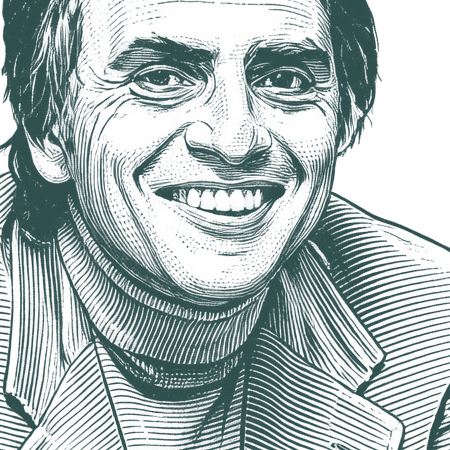
Да поддържаш съзнанието си отворено, е добродетел, но — както веднъж каза космическият инженер Джеймс Оубърг — трябва да не е много отворено, за да н… - Carl Sagan
""
Да поддържаш съзнанието си отворено, е добродетел, но — както веднъж каза космическият инженер Джеймс Оубърг — трябва да не е много отворено, за да не ти изпадне мозъкът.
Carl Edward Sagan (9 November 1934 – 20 December 1996) was an American astronomer, planetary scientist, cosmologist, astrophysicist, astrobiologist, author, and science communicator. His best known scientific contribution is research on extraterrestrial life, including experimental demonstration of the production of amino acids from basic chemicals by radiation. Sagan assembled the first physical messages sent into space, the Pioneer plaque and the Voyager Golden Record, universal messages that could potentially be understood by any extraterrestrial intelligence that might find them. Sagan argued the hypothesis, accepted since, that the high surface temperatures of Venus can be attributed to, and calculated using, the greenhouse effect. He testified to the US Congress in 1985 that the greenhouse effect will change the earth's climate system.
Biography information from
Wikiquote·
Portrait adapted from
Wikimedia Commons, NASA/JPL (Public domain / CC0)
Also Known As
Native Name:
Carl Edward Sagan
Alternative Names:
Sagan
•
Carl E. Sagan
•
Carl E Sagan
•
C. E. Sagan
•
C.E. Sagan
•
C E Sagan
•
C. Sagan
•
C Sagan
•
Sagan C
•
Sagan C.
•
Sagan C. E.
•
Sagan CE
«في كل مرة يقدم أحد التقارير العلمية قدرًا من المعلومات فإنه يكون مصحوبًا بهامش للخطأ — وهو تذكرة هادئة، ولكن دءوبة ومثابرة بأنه لا توجد أي معرفة بالغة الكمال أو منزهة عن الخطأ فهو قياس يُحدد مدى تصديقنا لما نعتقد أننا نعرفه، فإذا كانت هوامش الخطأ صغيرة، ترتفع دقة معرفتنا التجريبية، وإذا كانت هوامش الخطأ كبيرة، يرتفع، عندئذ، عدم اليقين بصدق معرفتنا، وفي غير الرياضيات البحتة لا يوجد شيء معروف على وجه اليقين.
Enhance Your Quote Experience
Enjoy ad-free browsing, unlimited collections, and advanced search features with Premium.
The quantity of 200-proof alcohol in this single interstellar cloud was more than enough to maintain the present population of the Earth, if every adult were a dedicated alcoholic, for the age of the solar system.