Only the middle distance and what may be called the remoter foreground are strictly human. When we look very near or very far, man either vanishes al… - Aldous Huxley

" "

Only the middle distance and what may be called the remoter foreground are strictly human. When we look very near or very far, man either vanishes altogether or loses his primacy. The astronomer looks even further afield than the Sung painter and sees even less of human life. At the other end of the scale the physicist, the chemist, the physiologist pursue the close-up – the cellular close-up, the molecular, the atomic and subatomic. Of that which, at twenty feet, even at arm's length, looked and sounded like a human being no trace remains.
Something analogous happens to the myopic artist and the happy lover. In the nuptial embrace personality is melted down; the individual (it is the recurrent theme of Lawrence's poems and novels) ceases to be himself and becomes a part of the vast impersonal universe.
And so it is with the artist who chooses to use his eyes at the near point. In his work humanity loses its importance, even disappears completely. Instead of men and women playing their fantastic tricks before high heaven, we are asked to consider the lilies, to meditate on the unearthly beauty of 'mere things,' when isolated from their utilitarian context and rendered as they are, in and for themselves. Alternatively (or, at an earlier stage of artistic development, exclusively), the nonhuman world of the near-point is rendered in patterns. These patterns are abstracted for the most part from leaves and flowers – the rose, the lotus, the acanthus, palm, papyrus – and are elaborated, with recurrences and variations, into something transportingly reminisce

English
Collect this quote

About Aldous Huxley

Aldous Leonard Huxley (26 July 1894 – 22 November 1963) was a British author known for his novel Brave New World. He was the grandson of Thomas Henry Huxley and younger brother of Julian Huxley.
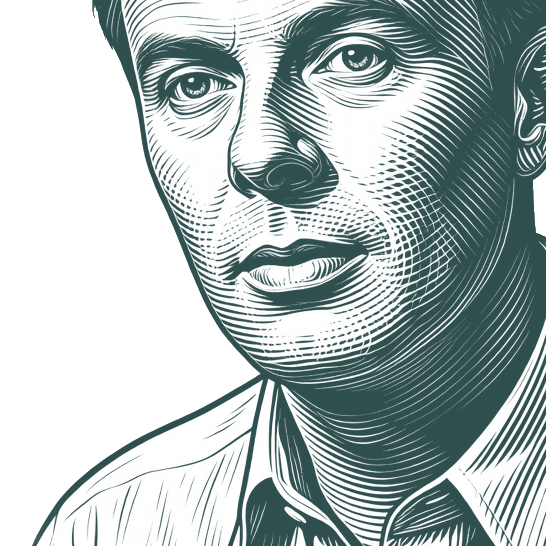
Biography information from Wikiquote

Also Known As

Birth Name: Aldous Leonard Huxley Arnold
Alternative Names: Aldous Leonard Huxley
Enhance Your Quote Experience

Enjoy ad-free browsing, unlimited collections, and advanced search features with Premium.

Related quotes. More quotes will automatically load as you scroll down, or you can use the load more buttons.

Additional quotes by Aldous Huxley

I'm pretty good at inventing phrases- you know, the sort of words that suddenly make you jump, almost as though you'd sat on a pin, they seem so new and exciting even though they're about something hypnopaedically obvious. But that doesn't seem enough. It's not enough for the phrases to be good; what you make with them ought to be good too...I feel I could do something much more important. Yes, and more intense, more violent. But what? What is there more important to say? And how can one be violent about the sort of things one's expected to write about? Words can be like X-rays, if you use them properly-they'll go through anything. You read them and you're pierced. That's one of the things I try to teach my students-how to write piercingly. But what on earth's the good of being pierced by an article about a Community Sing, or the latest improvement in scent organs? Besides, can you make words really piercing-you know, like the very hardest X-rays when you're writing about that sort of thing? Can you say something about nothing?

Works in ChatGPT, Claude, or Any AI

Add semantic quote search to your AI assistant via MCP. One command setup.

How have individuals been affected by the technological advances of recent years? Here is the answer to this question given by a philosopher-psychiatrist, Dr. Erich Fromm:

Our contemporary Western society, in spite of its material, intellectual and political progress, is increasingly less conducive to mental health, and tends to undermine the inner security, happiness, reason and the capacity for love in the individual; it tends to turn him into an automaton who pays for his human failure with increasing mental sickness, and with despair hidden under a frantic drive for work and so-called pleasure.

Our "increasing mental sickness" may find expression in neurotic symptoms. These symptoms are conspicuous and extremely distressing. But "let us beware," says Dr. Fromm, "of defining mental hygiene as the prevention of symptoms. Symptoms as such are not our enemy, but our friend; where there are symptoms there is conflict, and conflict always indicates that the forces of life which strive for integration and happiness are still fighting." The really hopeless victims of mental illness are to be found among those who appear to be most normal. "Many of them are normal because they are so well adjusted to our mode of existence, because their human voice has been silenced so early in their lives, that they do not even struggle or suffer or develop symptoms as the neurotic does." They are normal not in what may be called the absolute sense of the word; they are normal only in relation to a profoundly abnormal society. Their perfect adjustment to that abnormal society is a measure of their mental sickness. These millions of abnormally normal people, living without fuss in a society to which, if they were fully human beings, they ought not to be adjusted, still cherish "the illusion of individuality," but in fact they have been to a great extent deindividualized. Their conformity is developing into something like uniformity. But "uniformity and freedom are incompatible.

Loading...