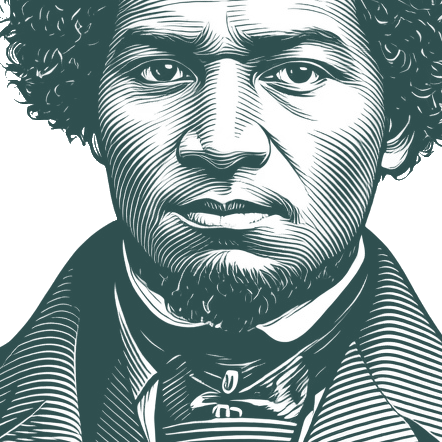
Who would be free themselves must strike the blow...I urge you to fly to arms and smite to death the power that would bury the Government and your li… - Frederick Douglass
""
Who would be free themselves must strike the blow...I urge you to fly to arms and smite to death the power that would bury the Government and your liberty in the same hopeless grave. This is your golden opportunity.
Frederick Douglass (c. February 1818 – 20 February 1895) was an American abolitionist, orator, author, editor, reformer, women's rights advocate, and statesman during the American Civil War. He was born a slave in Maryland, as Frederick Augustus Washington Bailey.
Biography information from
Wikiquote·
Portrait adapted from
Wikimedia Commons, Engraved by J.C. Buttre from a daguerreotype. (Public domain / CC0)
Also Known As
Birth Name:
Frederick Augustus Washington Bailey
Alternative Names:
Frederick Augustus Washington Baly
•
Fred Bailey
•
Freddie Bailey
Portrait from Wikimedia Commons. Credit: Engraved by J.C. Buttre from a daguerreotype.. Used under Public domain / CC0. Processed and styled by Quotewise.
Unlimited Quote Collections
Organize your favorite quotes without limits. Create themed collections for every occasion with Premium.
In the United States, the slightest infusion of Teutonic blood is thought to be sufficient to account for any considerable degree of intelligence found under any possible color of the skin.
Let us render the tyrant no aid; let us not hold the light by which he can trace the footprints of our flying brother.
Limited Time Offer
Premium members can get their quote collection automatically imported into their Quotewise collections.
There was a time when even brave men might look fearfully upon the destiny of the Republic; when our country was involved in a tangled network of contradictions; when vast and irreconcilable social forces fiercely disputed for ascendency and control; when a heavy curse rested upon our very soil, defying alike the wisdom and the virtue of the people to remove it; when our professions were loudly mocked by our practice, and our name was a reproach and a byword to a mocking; when our good ship of state, freighted with the best hopes of the oppressed of all nations, was furiously hurled against the hard and flinty rocks of derision, and every cord, bolt, beam and bend in her body quivered beneath the shock, there was some apology for doubt and despair. But that day has happily passed away. The storm has been weathered, and the portents are nearly all in our favor.