"The crystallized opposition of the segregationists was not unexpected; but we had only dimly foreseen the resistance that came from another quarter.… - Martin Luther King Jr.
"The crystallized opposition of the segregationists was not unexpected; but we had only dimly foreseen the resistance that came from another quarter. Victor Hugo has spoken of the "madmen of moderation" who are "un-paving hell." The descendants of Hugo's moderates appeared in the fall of 1963, bearing banners inscribed with the message: Order Before Justice.
For the most part, these moderates counted themselves as friends of the civil-rights movement; certainly they were in no sense moral bedfellows of the forces of segregation and violence. But they were now wrestling with a logic that an earlier, more passive, movement had never forced them to question. They had long settled on a simple compromise, one easy to accept and to live with. They could countenance token changes, and they had always believed these would make the Negro content. They were not asking him to stay in his old ghetto. They were ready to build a brand-new ghetto for him with a small exit door for a few. But the breath of the new movement chilled them. The Negro was insisting upon the mass application of equality to jobs, housing, education and social mobility. He sought a full life for a whole people. These moderates had come some distance in step with the thundering drums, but at the point of mass application they wanted the bugle to sound a retreat."
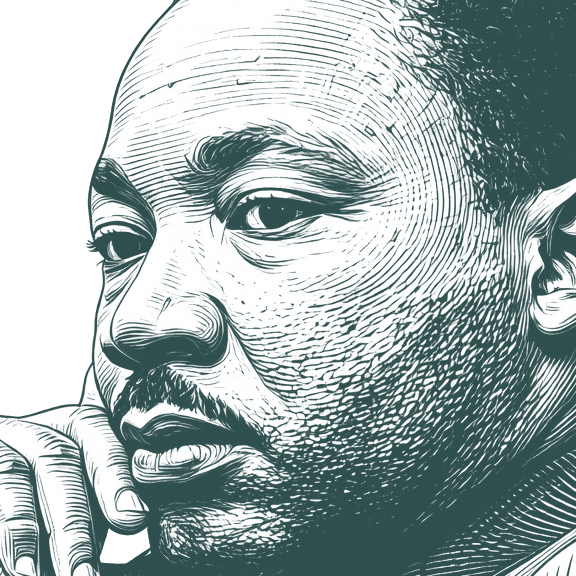
Dr. Martin Luther King Jr. (15 January 1929 – 4 April 1968) was an American Baptist minister, civil rights activist, and recipient of the Nobel Peace Prize of 1964. He was the husband of Coretta Scott King, and father of Yolanda King and Martin Luther King III.
Biography information from
Wikiquote·
Portrait adapted from
Wikimedia Commons, Yoichi Okamoto (Public domain / CC0)
Also Known As
Birth Name:
Michael King Jr.
Alternative Names:
Martin Luther King, Jr.
•
Dr. Martin Luther King, Jr.
•
Martin Luther King
•
Michael King
•
Dr. King
•
M. L. King
•
M.L. King
•
ML King
•
MLK
•
Martin Luther King Junior
•
Michael King Junior
•
Rev. Dr. Martin Luther King Jr.
•
The Rev. Dr. Martin Luther King Jr.
For the history of the centuries that have passed since the birth of Christ nowhere reveals conditions like those of the present. There has never been such building and planting in the world. There has never been such gluttonous and varied eating and drinking as now. Wearing apparel has reached its limit in costliness. Who has ever heard of such commerce as now encircles the earth? There have arisen all kinds of art and sculpture, embroidery and engraving, the like of which has not been seen during the whole Christian era. In addition men are so delving into the mysteries of things that today a boy of twenty knows more than twenty doctors formerly knew.
When you see a person squirming in the clutches of the Law, say to him: “Brother, get things straight. You let the Law talk to your conscience. Make it talk to your flesh.
Go Premium
Support Quotewise while enjoying an ad-free experience and premium features.