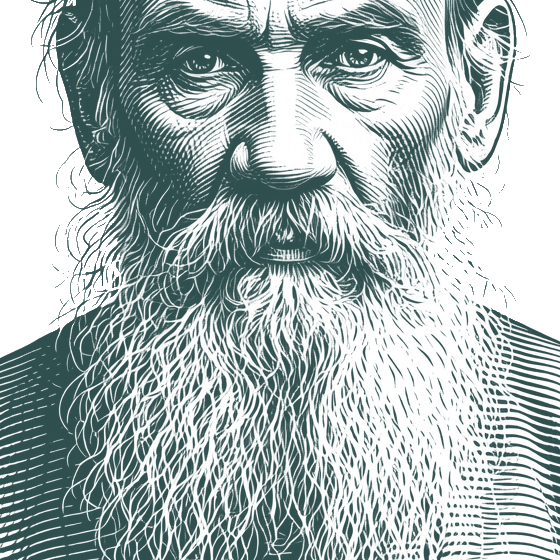
Art is not, as the metaphysicians say, the manifestation of some mysterious Idea of beauty or God; it is not, as the aesthetical physiologists say, [… - Leo Tolstoy

" "

Art is not, as the metaphysicians say, the manifestation of some mysterious Idea of beauty or God; it is not, as the aesthetical physiologists say, [play or] a game in which one releases surplus energy, ...not the production of pleasing objects, and is above all, not pleasure itself, but it is the means of union among mankind, joining them in the same feelings, and necessary for the life and progress toward the good of the individual and of humanity.

English
Collect this quote

About Leo Tolstoy

Lev Nikolayevitch Tolstoy [Ле́в Никола́евич Толсто́й, usually rendered Leo Tolstoy, or sometimes Tolstoi] (9 September 1828 – 20 November 1910) was a Russian writer, philosopher and social activist (social critic), whose novels War and Peace and Anna Karenina are internationally praised classics of world literature. He was a major influence on the development of Christian anarchism and pacifism, contributing to such nonviolent resistance movements as those of Mahatma Gandhi, Martin Luther King, Jr., and James Bevel.

Biography information from Wikiquote

Also Known As

Birth Name: Lev Nikolayevich Tolstoy
Native Name: Лев Никола́евич Толсто́й
Alternative Names: Count Lev Nikolayevich Tolstoy Tolstoy, Leo, graf, 1828-1910 Tolstoĭ, Lev Nikolaevich, graf, 1828-1910 Lev Nikolayevich Tolstoĭ Leo Tolstoi
Go Premium

Support Quotewise while enjoying an ad-free experience and premium features.

View Plans

Related quotes. More quotes will automatically load as you scroll down, or you can use the load more buttons.

Additional quotes by Leo Tolstoy

This new fraud is just like the old ones: its essence lies in substituting something external for the use of our own reason and conscience and that of our predecessors: in the Church teaching this external thing was revelation, in the scientific teaching it is observation. The trick played by this science is to destroy man's faith in reason and conscience by directing attention to the grossest deviations from the use of human reason and conscience, and having clothed the deception in a scientific theory, to assure them that by acquiring knowledge of external phenomena they will get to know indubitable facts which will reveal to them the law of man's life. And the mental demoralization consists in this, that coming to believe that things which should be decided by conscience and reason are decided by observation, these people lose their consciousness of good and evil and become incapable of understanding the expression and definitions of good and evil that have been formed by the whole preceding life of humanity. All this, in their jargon, is conditional and subjective. It must all be abandoned - they say - the truth cannot be understood by one's reason, for one may err, but there is another path which is infallible and almost mechanical: one must study facts. And facts must be studied on the basis of the scientists' science, that is, on the basis of two unfounded propositions: positivism and evolution which are put forward as indubitable truths. And the reigning science, with not less misleading solemnity than the Church, announces that the solution of all questions of life is only possible by the study of the facts of nature, and especially of organisms. A frivolous crowd of youths mastered by the novelty of this authority, which is as yet not merely not destroyed but not even touched by criticism, throws itself into the study of these facts of natural science as the sole path which, according to the assertions of the prevailing doctrine, can lead to the elucidation of the questions of life. But the further these disciples advance in this study the further and further are they removed not only from the possibility but even from the very thought of solving life's problems, and the more they become accustomed not so much to observe as to take on trust what they are told of the observations of others (to believe in cells, in protoplasm, in the fourth state of matter,1 &c.), the more and more does the form hide the contents from them; the more and more do they lose consciousness of good and evil and capacity to understand the expressions and definitions of good and evil worked out by the whole preceding life of humanity; the more and more do they adopt the specialized scientific jargon of conventional expressions which have no general human significance; the farther and farther do they wander among the debris of quite unilluminated observations; the more and more do they lose capacity not only to think independently but even to under-stand another man's fresh human thought lying outside their Talmud; and, what is most important, they pass their best years in growing unaccustomed to life, that is, to labour, and grow accustomed to consider their condition justified, while they become physically good-for-nothing parasites. And just like the theologians and the Talmudists they completely castrate their brains and become eunuchs of thought. And just like them, to the degree to which they become stupefied, they acquire a self-confidence which deprives them for ever of the possibility of returning to a simple clear and human way of thinking.

But one thing I beg of you, look on me as your friend; and if you want some help, advice, or simply want to open your heart to someone- not now, but when things are clearer in your heart- think of me.' He took her hand and kissed it. 'I shall be happy, if I am able...' Pierre was confused.
'Don't speak to me like that; I'm not worth it!' cried Natasha...
'Hush, hush your whole life lies before you,' he said to her.
'Before me! No! All is over for me,' she said, with shame and humiliation.
'All over?' he repeated. 'If I were not myself, but the handsomest, cleverest, best man in the world, and if I were free I would be on my knees this minute to beg for your hand and your love.

Loading...