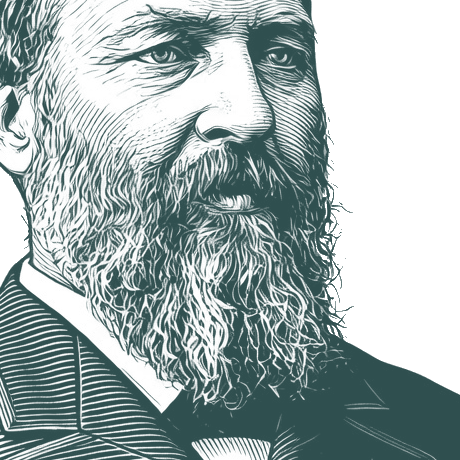
The men who succeed best in public life are those who take the risk of standing by their own convictions. - James A. Garfield
""
The men who succeed best in public life are those who take the risk of standing by their own convictions.
English
Collect this quote
About
James A. Garfield
James Abram Garfield (19 November 1831 – 19 September 1881) was the 20th president of the United States of America in 1881, and the second U.S. president to be assassinated. His term was the second shortest in U.S. history, after William Henry Harrison's. Holding office from March to September of 1881, President Garfield was in office for a total of just six months and fifteen days. A Republican, he supported civil rights and freedoms for African Americans.
Biography information from
Wikiquote·
Portrait adapted from
Wikimedia Commons, Unknown; part of Brady-Handy Photograph Collection. (Public domain / CC0)
Also Known As
Birth Name:
James Abram Garfield
Alternative Names:
James Garfield
•
J. A. Garfield
•
J. Garfield
•
President Garfield
Portrait from Wikimedia Commons. Credit: Unknown; part of Brady-Handy Photograph Collection.. Used under Public domain / CC0. Processed and styled by Quotewise.
Go Premium
Support Quotewise while enjoying an ad-free experience and premium features.
The House has today resolved to enter upon a revolution against the Constitution and Government of the United States... [N]othing less than the total subversion of this government.
I never meet a ragged boy in the street without feeling that i may owe him a salute, for I know not what possibilities may be buttoned up under his coat.
Enhance Your Quote Experience
Enjoy ad-free browsing, unlimited collections, and advanced search features with Premium.
The distinguished gentleman who introduced the bill from the committee very appropriately said that it requires us to enter upon unexplored territory. That territory, Mister Speaker, is the neutral ground of all political philosophy, — the neutral ground for which rival theories have been struggling in all ages. There are two ideas so utterly antagonistic that when, in any nation, either has gained absolute and complete possession of that neutral ground, the ruin of that nation has invariably followed. The one is that despotism which swallows and absorbs all power in a single central government; the other is that extreme doctrine of local sovereignty which makes nationality impossible, and resolves a general government into anarchy and chaos. It makes but little difference as to the final result which of these ideas drives the other from the field; in either case, ruin follows. The result exhibited by the one was seen in the United Netherlands, which Madison, in the Federalist, describes as characterized by "imbecility in the government; discord among the provinces; foreign influence and indignities.