The pilot, who was an intelligent man, had listened in silence to the talk till he was asked to speak. Now every one turned to him, and he said: You … - Leo Tolstoy
""
The pilot, who was an intelligent man, had listened in silence to the talk till he was asked to speak. Now every one turned to him, and he said: You are all misleading one another, and are yourselves deceived. The sun does not go round the earth, but the earth goes round the sun, revolving as it goes, and turning towards the sun in the course of each twenty-four hours, not only Japan, and the Philippines, and Sumatra where we now are, but Africa, and Europe, and America, and many lands besides. The sun does not shine for some one mountain, or for some one island, or for some one sea, nor even for one earth alone, but for other planets as well as our earth. If you would only look up at the heavens, instead of at the ground beneath your own feet, you might all understand this, and would then no longer suppose that the sun shines for you, or for your country alone. Thus spoke the wise pilot, who had voyaged much about the world, and had gazed much upon the heavens above.
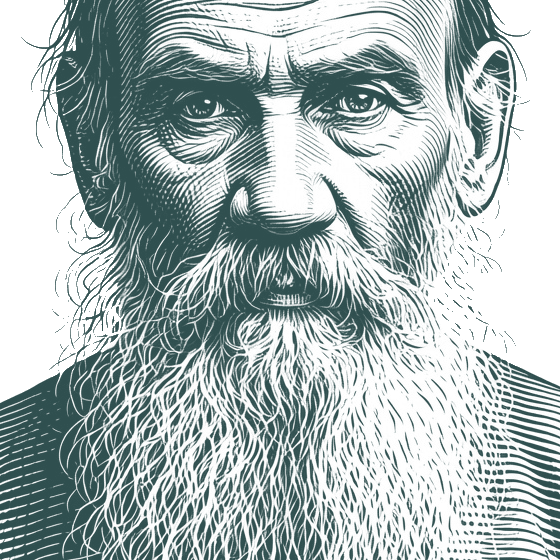
Lev Nikolayevitch Tolstoy [Ле́в Никола́евич Толсто́й, usually rendered Leo Tolstoy, or sometimes Tolstoi] (9 September 1828 – 20 November 1910) was a Russian writer, philosopher and social activist (social critic), whose novels War and Peace and Anna Karenina are internationally praised classics of world literature. He was a major influence on the development of Christian anarchism and pacifism, contributing to such nonviolent resistance movements as those of Mahatma Gandhi, Martin Luther King, Jr., and James Bevel.
Biography information from
Wikiquote·
Portrait adapted from
Wikimedia Commons, Sergei Prokudin-Gorskii (Public domain / CC0)
Also Known As
Pen Names:
Л. Н. Т.
•
Л. Н.
Birth Name:
Lev Nikolayevich Tolstoy
Native Name:
Лев Никола́евич Толсто́й
Alternative Names:
Count Lev Nikolayevich Tolstoy
•
Tolstoy, Leo, graf, 1828-1910
•
Tolstoĭ, Lev Nikolaevich, graf, 1828-1910
•
Lev Nikolayevich Tolstoĭ
•
Leo Tolstoi
•
Tolstoĭ, Lev Nikolaevich, graf
•
Tolstoy, Leo, graf
When Levin thought what he was and what he was living for, he could find no answer to the questions and was reduced to despair; but when he left off questioning himself about it, it seemed as though he knew both what he was and what he was living for, acting and living resolutely and without hesitation.
Works in ChatGPT, Claude, or Any AI
Add semantic quote search to your AI assistant via MCP. One command setup.
Darkness had fallen upon everything for him; but just because of this darkness he felt that the one guiding clue in the darkness was his work, and he clutched it and clung to it with all his strength.