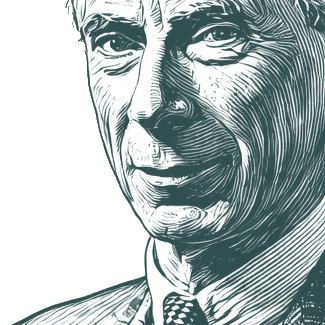
If throughout your life you abstain from murder, theft, fornication, perjury, blasphemy, and disrespect toward your parents, your church, and your ki… - Bertrand Russell
""
If throughout your life you abstain from murder, theft, fornication, perjury, blasphemy, and disrespect toward your parents, your church, and your king, you are conventionally held to deserve moral admiration even if you have never done a single kind or generous or useful action. This very inadequate notion of virtue is an outcome of taboo morality, and has done untold harm.
Bertrand Arthur William Russell, 3rd Earl Russell (May 18, 1872 – February 2, 1970) was a British philosopher, logician, mathematician, historian, and social critic. In 1950, he was awarded a Nobel Prize in Literature.
Biography information from
Wikiquote·
Portrait adapted from
Wikimedia Commons, Bassano Ltd (Public domain / CC0)
Also Known As
Birth Name:
Bertrand Arthur William Russell
Alternative Names:
Bertrand Russell, 3rd Earl Russell
•
Bertrand Russell, Earl Russell
•
Bertrand Arthur William Russell, 3rd Earl Russell
•
Russell
The trouble arises from the generally received philosophy of life, according to which life is a contest, a competition, in which respect is to be a ccorded to the victor. This view leads to an undue cultivation of the will at the expense of the senses and the intellect.
Many orthodox people speak as though it were the business of sceptics to disprove received dogmas rather than of dogmatists to prove them. This is, of course, a mistake. If I were to suggest that between the Earth and Mars there is a china teapot revolving about the sun in an elliptical orbit, nobody would be able to disprove my assertion provided I were careful to add that the teapot is too small to be revealed even by our most powerful telescopes. But if I were to go on to say that, since my assertion cannot be disproved, it is intolerable presumption on the part of human reason to doubt it, I should rightly be thought to be talking nonsense. If, however, the existence of such a teapot were affirmed in ancient books, taught as the sacred truth every Sunday, and instilled into the minds of children at school, hesitation to believe in its existence would become a mark of eccentricity and entitle the doubter to the attentions of the psychiatrist in an enlightened age or of the Inquisitor in an earlier time.
Enhance Your Quote Experience
Enjoy ad-free browsing, unlimited collections, and advanced search features with Premium.
Philosophy, for Plato, is a kind of vision, the 'vision of truth' ... Everyone who has done any kind of creative work has experienced, in a greater or less degree, the state of mind in which, after long labour, truth or beauty appears, or seems to appear, in a sudden glory – it may only be about some small matter, or it may be about the universe ... I think most of the best creative work, in art, in science, in literature, and in philosophy, has been the result of such a moment.