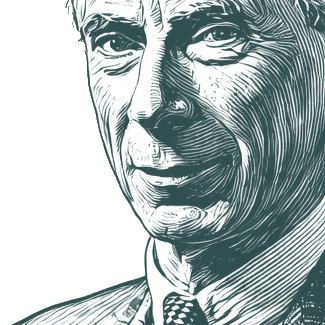
Philosophy, for Plato, is a kind of vision, the 'vision of truth' ... Everyone who has done any kind of creative work has experienced, in a greater o… - Bertrand Russell
""
Philosophy, for Plato, is a kind of vision, the 'vision of truth' ... Everyone who has done any kind of creative work has experienced, in a greater or less degree, the state of mind in which, after long labour, truth or beauty appears, or seems to appear, in a sudden glory – it may only be about some small matter, or it may be about the universe ... I think most of the best creative work, in art, in science, in literature, and in philosophy, has been the result of such a moment.
Bertrand Arthur William Russell, 3rd Earl Russell (May 18, 1872 – February 2, 1970) was a British philosopher, logician, mathematician, historian, and social critic. In 1950, he was awarded a Nobel Prize in Literature.
Biography information from
Wikiquote·
Portrait adapted from
Wikimedia Commons, Bassano Ltd (Public domain / CC0)
Also Known As
Birth Name:
Bertrand Arthur William Russell
Alternative Names:
Bertrand Russell, 3rd Earl Russell
•
Bertrand Russell, Earl Russell
•
Bertrand Arthur William Russell, 3rd Earl Russell
•
Russell
Man is essentially a dreamer, wakened sometimes for a moment by some peculiarly obtrusive element in the outer world, but lapsing again quickly into the happy somnolence of imagination. Freud has shown how largely our dreams at night are the pictured fulfilment of our wishes; he has, with an equal measure of truth, said the same of day-dreams; and he might have included the day-dreams which we call beliefs.
To fear love is to fear life, and those who fear life are already three parts dead.
Go Premium
Support Quotewise while enjoying an ad-free experience and premium features.
Here, as usually in philosophy, the first difficulty is to see that the problem is difficult. If you say to a person untrained in philosophy, "How do you know I have two eyes?" he or she will reply, "What a silly question! I can see you have." It is not to be supposed that, when our inquiry is finished, we shall have arrived at anything radically different from this unphilosophical position. What will have happened will be that we shall have come to see a complicated structure where we thought everything was simple, that we shall have become aware of the penumbra of uncertainty surrounding the situations which inspire no doubt, that we shall find doubt more frequently justified than we supposed, and that even the most plausible premisses will have shown themselves capable of yielding unplausible conclusions. The net result is to substitute articulate hesitation for inarticulate certainty.