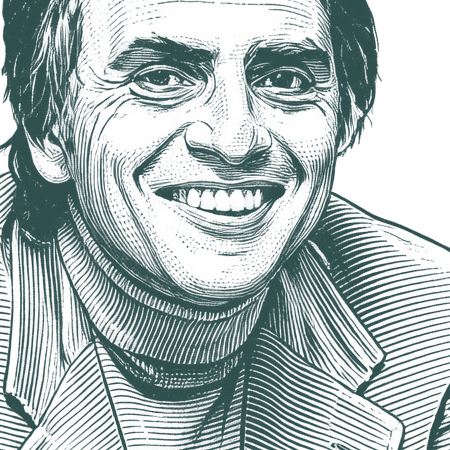
"In a time in some respect similar to our own, St. Augustine of Hippo, after a lusty and intellectually inventive young manhood, withdrew from the wo… - Carl Sagan
"In a time in some respect similar to our own, St. Augustine of Hippo, after a lusty and intellectually inventive young manhood, withdrew from the world of sense and intellect and advised others to do likewise; "There is another form of temptation, even more fraught with danger. This is the disease of curiosity... It is this which drives us on to try to discover the secrets of nature, those secrets which are beyond our understanding, which can avail us nothing and which men should not wish to learn... In this immense forest full of pitfalls and perils, I have drawn myself back, and pulled myself away from these thorns. In the midst of all these things which float unceasingly around me in everyday life, I am never surprised at any of them, and never captivated by my genuine desire to study them... I no longer dream about the stars." The time of Augustine's death, 430 ce., marks the beginning of the Dark Age in Europe."
English
Collect this quote
About
Carl Sagan
Carl Edward Sagan (9 November 1934 – 20 December 1996) was an American astronomer, planetary scientist, cosmologist, astrophysicist, astrobiologist, author, and science communicator. His best known scientific contribution is research on extraterrestrial life, including experimental demonstration of the production of amino acids from basic chemicals by radiation. Sagan assembled the first physical messages sent into space, the Pioneer plaque and the Voyager Golden Record, universal messages that could potentially be understood by any extraterrestrial intelligence that might find them. Sagan argued the hypothesis, accepted since, that the high surface temperatures of Venus can be attributed to, and calculated using, the greenhouse effect. He testified to the US Congress in 1985 that the greenhouse effect will change the earth's climate system.
Biography information from
Wikiquote·
Portrait adapted from
Wikimedia Commons, NASA/JPL (Public domain / CC0)
Also Known As
Native Name:
Carl Edward Sagan
Alternative Names:
Sagan
•
Carl E. Sagan
•
Carl E Sagan
•
C. E. Sagan
•
C.E. Sagan
•
C E Sagan
•
C. Sagan
•
C Sagan
•
Sagan C
•
Sagan C.
•
Sagan C. E.
•
Sagan CE
The cosmos is all that is or ever was or ever will be. Our feeblest contemplations of the Cosmos stir us - there is a tingling in the spine, a catch in the voice, a faint sensation, as if a distant memory, of falling from a great height. We know we are approaching the greatest of mysteries.
Proponents of doctrinal religions—ones in which a particular body of belief is prized and infidels scorned—will be threatened by the courageous pursuit of knowledge. We hear from such people that it may be dangerous to probe too deeply. Many people have inherited their religion like their eye color: they consider it not a thing to think very deeply about, and in any case beyond our control. But those with a set of beliefs they profess to feel deeply about, which they have selected without an unbiased sifting through the facts and the alternatives, will feel uncomfortably challenged by searching questions. Anger at queries about our beliefs is the body's warning signal: here lies unexamined and probably dangerous doctrinal baggage.
Unlimited Quote Collections
Organize your favorite quotes without limits. Create themed collections for every occasion with Premium.
I've been searching, Eleanor. After all these years, believe me, I know the truth when I see it. Any faith that admires truth, that strives to know God, must be brave enough to accomodate the universe. I mean the real universe. All those light-years. All those worlds. I thing of the scope of your universe, the opportunities it affords the Creator, and it takes my breath away. It's much better than bottling Him up in one small world. I never liked the idea of Earth as God's green footstool. It was too reassuring, like a children's story... like a tranquilizer. But your universe has room enough, and time enough, for the kind of God I believe in.