We all know what the negro has been as a slave. In this relation we have his experience of two hundred and fifty years before us, and can easily know… - Frederick Douglass
""
We all know what the negro has been as a slave. In this relation we have his experience of two hundred and fifty years before us, and can easily know the character and qualities he has developed and exhibited during this long and severe ordeal. In his new relation to his environments, we see him only in the twilight of twenty years of semi-freedom; for he has scarcely been free long enough to outgrow the marks of the lash on his back and the fetters on his limbs. He stands before us, today, physically, a maimed and mutilated man. His mother was lashed to agony before the birth of her babe, and the bitter anguish of the mother is seen in the countenance of her offspring. Slavery has twisted his limbs, shattered his feet, deformed his body and distorted his features. He remains black, but no longer comely. Sleeping on the dirt floor of the slave cabin in infancy, cold on one side and warm on the other, a forced circulation of blood on the one side and chilled and retarded circulation on the other, it has come to pass that he has not the vertical bearing of a perfect man. His lack of symmetry, caused by no fault of his own, creates a resistance to his progress which cannot well be overestimated, and should be taken into account, when measuring his speed in the new race of life upon which he has now entered.
English
Collect this quote
About
Frederick Douglass
Frederick Douglass (c. February 1818 – 20 February 1895) was an American abolitionist, orator, author, editor, reformer, women's rights advocate, and statesman during the American Civil War. He was born a slave in Maryland, as Frederick Augustus Washington Bailey.
Biography information from
Wikiquote·
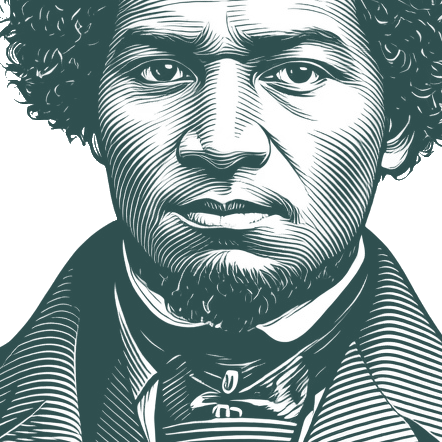
Portrait adapted from
Wikimedia Commons, Engraved by J.C. Buttre from a daguerreotype. (Public domain / CC0)
Also Known As
Birth Name:
Frederick Augustus Washington Bailey
Alternative Names:
Frederick Augustus Washington Baly
•
Fred Bailey
•
Freddie Bailey
Equally clear is the right to hear. To suppress free speech is a double wrong. It violates the rights of the hearer as well as those of the speaker. It is just as criminal to rob a man of his right to speak and hear as it would be to rob him of his money.
I assert most unhesitatingly, that the religion of the South — as I have observed it and proved it — is a mere covering for the most horrid crimes; a justifier of the most appalling barbarity; a sanctifier of the most hateful frauds; and a dark shelter, under which the darkest, foulest, grossest, and most infernal abominations fester and flourish. Were I again to be reduced to the condition of A slave, next to that calamity, I should regard the fact of being the slave of a religious slaveholder, the greatest that could befall me.
Try QuoteGPT
Chat naturally about what you need. Each answer links back to real quotes with citations.
Shoot down the Confederacy and uphold the flag; the American flag.