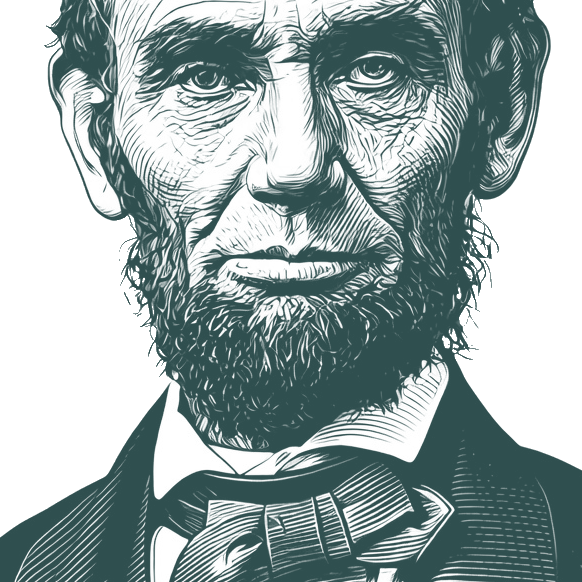
Soldiers — You are about to return to your homes and your friends, after having, as I learn, performed in camp a comparatively short term of duty in … - Abraham Lincoln
""
Soldiers — You are about to return to your homes and your friends, after having, as I learn, performed in camp a comparatively short term of duty in this great contest. I am greatly obliged to you, and to all who have come forward at the call of their country.
English
Collect this quote
About
Abraham Lincoln
Abraham Lincoln (12 February 1809 – 15 April 1865) was the 16th president of the United States, serving from March 1861 until his assassination in April 1865. Initially entering politics as a Whig, he became a member of the US congress from Illinois, and later the first Republican president, leading Union forces throughout the moral, constitutional, political and military crises of the American Civil War, during which he abolished slavery and strengthened the U.S. government.
Biography information from
Wikiquote·
Portrait adapted from
Wikimedia Commons, Alexander Gardner (Public domain / CC0)
Also Known As
Alternative Names:
Honest Abe
•
President Lincoln
•
Abe Lincoln
•
Uncle Abe
•
A. Lincoln
•
Lincoln
I know of nothing so pleasant to the mind, as the discovery of anything which is at once new and valuable — nothing which so lightens and sweetens toil, as the hopeful pursuit of such discovery.
All this is not the result of accident. It has a philosophical cause. Without the Constitution and the Union, we could not have attained the result; but even these, are not the primary cause of our great prosperity. There is something back of these, entwining itself more closely about the human heart. That something, is the principle of "Liberty to all" — the principle that clears the path for all — gives hope to all — and, by consequence, enterprize, and industry to all. The expression of that principle, in our Declaration of Independence, was most happy, and fortunate. Without this, as well as with it, we could have declared our independence of Great Britain; but without it, we could not, I think, have secured our free government, and consequent prosperity. No oppressed, people will fight, and endure, as our fathers did, without the promise of something better, than a mere change of masters. The assertion of that principle, at that time, was the word, "fitly spoken" which has proved an "apple of gold" to us. The Union, and the Constitution, are the picture of silver, subsequently framed around it. The picture was made, not to conceal, or destroy the apple; but to adorn, and preserve it. The picture was made for the apple — not the apple for the picture. So let us act, that neither picture, or apple shall ever be blurred, or bruised or broken. That we may so act, we must study, and understand the points of danger.
Works in ChatGPT, Claude, or Any AI
Add semantic quote search to your AI assistant via MCP. One command setup.
The world is agreed that labor is the source from which human wants are mainly supplied. There is no dispute upon this point. From this point, however, men immediately diverge. Much disputation is maintained as to the best way of applying and controlling the labor element. By some it is assumed that labor is available only in connection with capital — that nobody labors, unless somebody else, owning capital, somehow, by the use of that capital, induces him to do it. Having assumed this, they proceed to consider whether it is best that capital shall hire laborers, and thus induce them to work by their own consent; or buy them, and drive them to it without their consent. Having proceeded so far they naturally conclude that all laborers are necessarily either hired laborers, or slaves. They further assume that whoever is once a hired laborer, is fatally fixed in that condition for life; and thence again that his condition is as bad as, or worse than that of a slave. This is the "mud-sill" theory. … By the "mud-sill" theory it is assumed that labor and education are incompatible; and any practical combination of them impossible. According to that theory, a blind horse upon a tread-mill, is a perfect illustration of what a laborer should be — all the better for being blind, that he could not tread out of place, or kick understandingly. According to that theory, the education of laborers, is not only useless, but pernicious, and dangerous. In fact, it is, in some sort, deemed a misfortune that laborers should have heads at all.