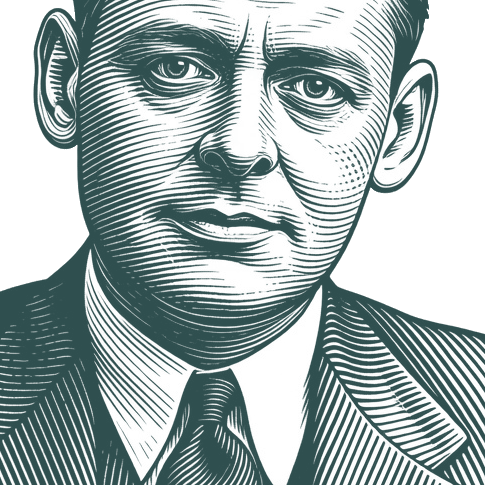
Thomas Stearns Eliot (26 September 1888 – 4 January 1965) was an American-born English poet, dramatist and literary critic. Noted for spiritual and religious themes in many of his poems, he converted from Unitarianism to Anglicanism in 1927.
Biography information from
Wikiquote·
Portrait adapted from
Wikimedia Commons, Thomas Stearns Eliot with his sister and his cousin by Lady Ottoline Morrell.jpg: Lady Ottoline Morrell (1873–1938) derivative work: Octave.H (Public domain / CC0)
Also Known As
Birth Name:
Thomas Stearns Eliot
Alternative Names:
Eliot
•
T S Eliot
•
Thomas Eliot
•
T.S. Eliot
Portrait from Wikimedia Commons. Credit: Thomas Stearns Eliot with his sister and his cousin by Lady Ottoline Morrell.jpg: Lady Ottoline Morrell (1873–1938) derivative work: Octave.H. Used under Public domain / CC0. Processed and styled by Quotewise.
Enhance Your Quote Experience
Enjoy ad-free browsing, unlimited collections, and advanced search features with Premium.
Time present and time past Are both perhaps present in time future, And time future contained in time past. If all time is eternally present All time is unredeemable. What might have been is an abstraction Remaining a perpetual possibility Only in a world of speculation. What might have been and what has been Point to one end, which is always present. Footfalls echo in the memory Down the passage which we did not take Towards the door we never opened Into the rose-garden. My words echo Thus, in your mind. But to what purpose Disturbing the dust on a bowl of rose-leaves I do not know. Other echoes Inhabit the garden. Shall we follow?”
<...>
Go, said the bird, for the leaves were full of children, Hidden excitedly, containing laughter. Go, go, go, said the bird: human kind Cannot bear very much reality. Time past and time future What might have been and what has been Point to one end, which is always present.
If you haven’t the strength to impose your own terms upon life, then you must accept the terms it offers you.
Time present and time past Are both perhaps present in time future And time future contained in time past. If all time is eternally present All time is unredeemable. What might have been is an abstraction Remaining a perpetual possibility Only in a world of speculation. What might have been and what has been Point to one end, which is always present.