Man has, as it were, become a kind of prosthetic God. - Sigmund Freud
""
Man has, as it were, become a kind of prosthetic God.
English
Collect this quote
About
Sigmund Freud
Sigmund Freud ([ˈziːgmʊnt ˈfrɔʏ̯t]; 6 May 1856 – 23 September 1939) was an Austrian neurologist and psychiatrist and the founder of the psychoanalytic school of psychology. He was the father of Anna Freud, the grandfather of Sir Clement Freud and Lucian Freud, and the uncle of Edward Bernays.
Biography information from
Wikiquote·
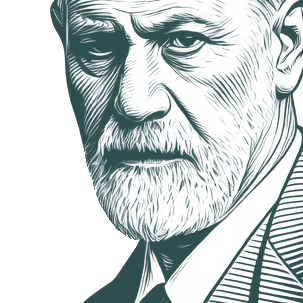
Portrait adapted from
Wikimedia Commons, Max Halberstadt (Public domain / CC0)
Many of us will also find it hard to abandon our belief that in man himself there dwells an impulse towards perfection, which has brought him to his present heights of intellectual prowess and ethical sublimation, and from which it might be expected that his development into superman will be ensured. But I do not believe in the existence of such an inner impulse, and I see no way of preserving this pleasing illusion. The development of man up to now does not seem to me to need any explanation differing from that of animal development, and the restless striving towards further perfection which may be observed in a minority of human beings is easily explicable as the result of that repression of instinct upon which what is most valuable in human culture is built.
we are threatened with suffering from three directions: from our body, which is doomed to decay..., from the external world which may rage against us with overwhelming and merciless force of destruction, and finally from our relations with other men... This last source is perhaps more painful to use than any other. (p77)
"Three tendencies can be observed in the estimation of dreams. Many philosophers have given currency to one of these tendencies, one which at the same time preserves something of the dream's former over-valuation. The foundation of dream life is for them a peculiar state of psychical activity, which they even celebrate as elevation to some higher state. Schubert, for instance, claims: "The dream is the liberation of the spirit from the pressure of external nature, a detachment of the soul from the fetters of matter." Not all go so far as this, but many maintain that dreams have their origin in real spiritual excitations, and are the outward manifestations of spiritual powers whose free movements have been hampered during the day ("Dream Phantasies," Scherner, Volkelt). A large number of observers acknowledge that dream life is capable of extraordinary achievements — at any rate, in certain fields ("Memory")."