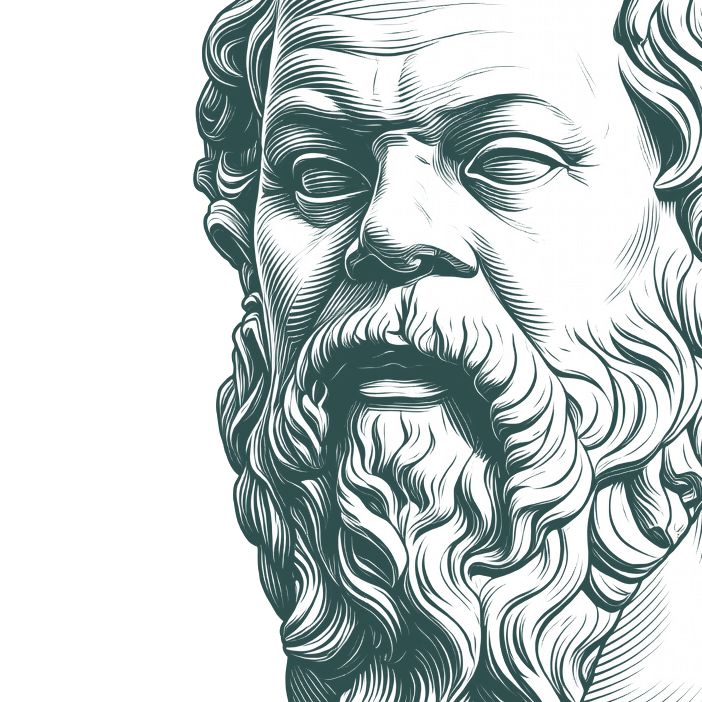
Socrates (Σωκράτης; c. 470 BC – 399 BC) was a classical Greek (Athenian) philosopher credited as one of the founders of Western philosophy. Through his portrayal in Plato's dialogues, Socrates has become renowned for his contribution to the field of ethics, and it is this Platonic Socrates who lends his name to the concepts of Socratic irony and the Socratic method, or elenchus. The latter remains a commonly used tool in a wide range of discussions, and is a type of pedagogy in which a series of questions is asked not only to draw individual answers, but also to encourage fundamental insight into the issue at hand.
Biography information from
Wikiquote·
Portrait adapted from
Wikimedia Commons, Copy of Lysippos (?) (Public domain / CC0)
Đó là một câu hỏi phức tạp, mà đời người thì ngắn ngủi.
In this present life, I reckon that we make the nearest approach to knowledge when we have the least possible concern or interest in the body, and are not saturated with the bodily nature, but remain pure until the hour when God himself is pleased to release us. And then the foolishness of the body will be cleared away and we shall be pure and hold converse with other pure souls, and know of ourselves the clear light everywhere; and this is surely the light of truth. For no impure thing is allowed to approach the pure. These are the sort of words, Simmias, which the true lovers of wisdom cannot help saying to one another, and thinking.
Unlimited Quote Collections
Organize your favorite quotes without limits. Create themed collections for every occasion with Premium.