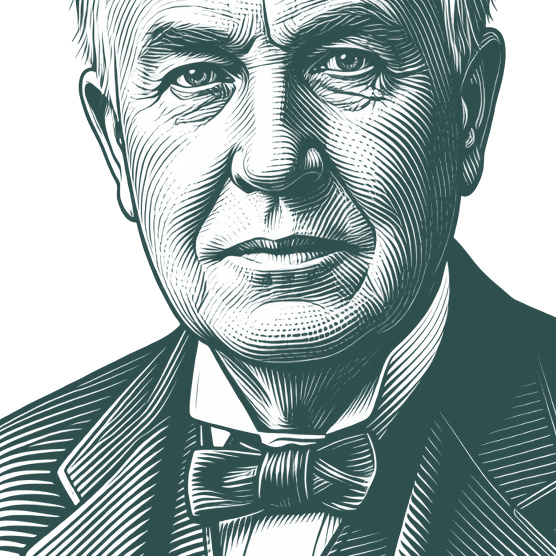
During all those years of experimentation and research, I never once made a discovery. All my work was deductive, and the results I achieved were tho… - Thomas Edison
""
During all those years of experimentation and research, I never once made a discovery. All my work was deductive, and the results I achieved were those of invention, pure and simple. I would construct a theory and work on its lines until I found it was untenable. Then it would be discarded at once and another theory evolved. This was the only possible way for me to work out the problem. … I speak without exaggeration when I say that I have constructed 3,000 different theories in connection with the electric light, each one of them reasonable and apparently likely to be true. Yet only in two cases did my experiments prove the truth of my theory. My chief difficulty was in constructing the carbon filament. . . . Every quarter of the globe was ransacked by my agents, and all sorts of the queerest materials used, until finally the shred of bamboo, now utilized by us, was settled upon.
English
Collect this quote
About
Thomas Edison
Thomas Alva Edison (11 February 1847 – 18 October 1931) was an American inventor and businessman who developed many devices which greatly influenced life worldwide into the twenty-first century.
Biography information from
Wikiquote·
Portrait adapted from
Wikimedia Commons, Louis Bachrach, Bachrach Studios, restored by Michel Vuijlsteke (Public domain / CC0)
We really haven't got any great amount of data on the subject, and without data how can we reach any definite conclusions? All we have — everything — favors the idea of what religionists call the "Hereafter." Science, if it ever learns the facts, probably will find another more definitely descriptive term.
Tom Paine has almost no influence on present-day thinking in the United States because he is unknown to the average citizen. Perhaps I might say right here that this is a national loss and a deplorable lack of understanding concerning the man who first proposed and first wrote those impressive words, 'the United States of America.' But it is hardly strange. Paine's teachings have been debarred from schools everywhere and his views of life misrepresented until his memory is hidden in shadows, or he is looked upon as of unsound mind. We never had a sounder intelligence in this Republic. He was the equal of Washington in making American liberty possible. Where Washington performed Paine devised and wrote. The deeds of one in the Weld were matched by the deeds of the other with his pen.
Many a person who could not comprehend Rousseau, and would be puzzled by Montesquieu, could understand Paine as an open book. He wrote with a clarity, a sharpness of outline and exactness of speech that even a schoolboy should be able to grasp. There is nothing false, little that is subtle, and an impressive lack of the negative in Paine. He literally cried to his reader for a comprehending hour, and then filled that hour with such sagacious reasoning as we find surpassed nowhere else in American letters — seldom in any school of writing.