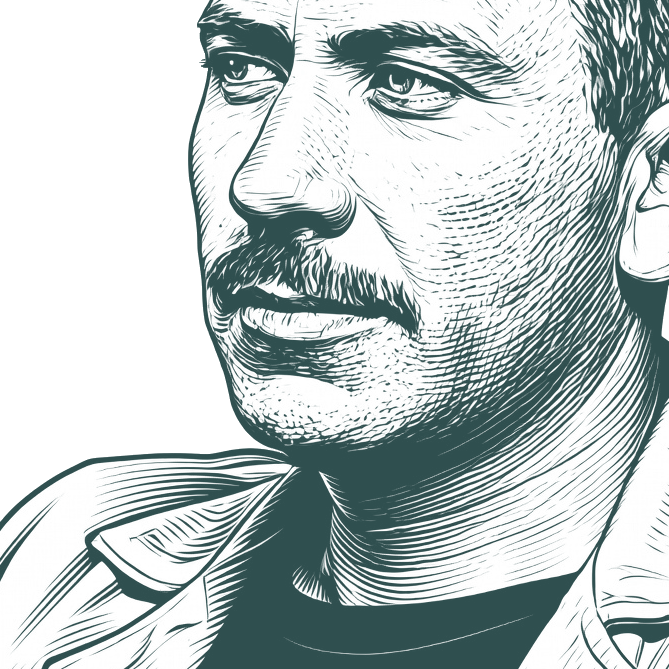
John Ernst Steinbeck Jr. (27 February 1902 – 20 December 1968) was an American writer. A recipient of the Nobel Prize for Literature in 1962, his works include the novella Of Mice and Men (1937) and the novel The Grapes of Wrath (1939, Pulitzer Prize for Fiction, 1940), both of which examine the lives of the working class and migrant workers during the Great Depression.
Biography information from
Wikiquote·
Portrait adapted from
Wikimedia Commons, McFadden Publications, Inc.; no photographer credited; photo likely the work of Sonya Noskowiak, as Steinbeck is wearing the same clothes from her 1935 studio session that produced the work shown here: https://www.si.edu/object/npg_NPG.2006.74 (Public domain / CC0)
Also Known As
Birth Name:
Jeffery Ernest Steinbeck
Alternative Names:
John Ernst Steinbeck, Jr.
•
John Ernst Steinbeck
•
John Ernest Steinbeck
•
John Ernst Steinbeck Jr
•
Steinbeck
Portrait from Wikimedia Commons. Credit: McFadden Publications, Inc.; no photographer credited; photo likely the work of Sonya Noskowiak, as Steinbeck is wearing the same clothes from her 1935 studio session that produced the work shown here: https://www.si.edu/object/npg_NPG.2006.74. Used under Public domain / CC0. Processed and styled by Quotewise.
Works in ChatGPT, Claude, or Any AI
Add semantic quote search to your AI assistant via MCP. One command setup.
You know most people live ninety per cent in the past, seven per cent in the present, and that only leaves them three per cent for the future.
He saw something that makes a man doubtful of the constancy of the realities outside himself. It was the shocking discovery that makes a man wonder if I've missed this, what else have I failed to see?
Works in ChatGPT, Claude, or Any AI
Add semantic quote search to your AI assistant via MCP. One command setup.
A number of years ago I had some experience with being alone. For two succeeding years I was alone each winter for eight months at a stretch in the Sierra Nevada mountains on Lake Tahoe. I was the caretaker on a summer estate during the winter months when it was snowed in. And I made some observations then. As time went on I found that my reactions thickened. Ordinarily I am a whistler. I stopped whistling. I stopped conversing with my dogs, and I believe that the subtleties of feeling began to disappear until finally I was on a pleasure-pain basis. Then it occurred to me that the delicate shades of feeling, of reaction, are the result of communication, and without such communication they tend to disappear. A man with nothing to say has no words. Can its reverse be true- a man who has no one to say anything to has no words as he has no need for words? ... Only through imitation do we develop toward originality.