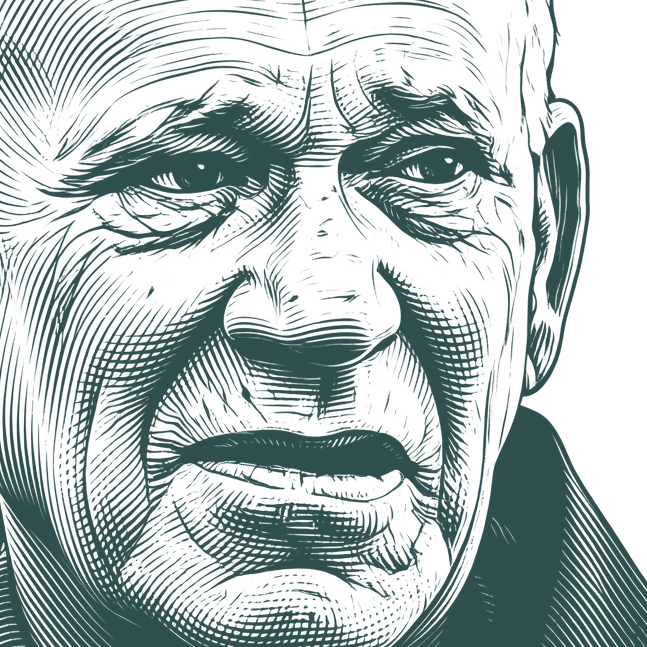
Man is a luxury-loving animal. Take away play, fancies, and luxuries, and you will turn man into a dull, sluggish creature, barely energetic enough t… - Eric Hoffer
""
Man is a luxury-loving animal. Take away play, fancies, and luxuries, and you will turn man into a dull, sluggish creature, barely energetic enough to obtain a bare subsistence. A society becomes stagnant when its people are too rational or too serious to be tempted by baubles.
English
Collect this quote
About
Eric Hoffer
Eric Hoffer (25 July 1902 – 21 May 1983) was an American writer on social and political philosophy. His first book, The True Believer: Thoughts On The Nature Of Mass Movements (1951) is widely recognized as a classic on mass-movements and the psychological roots of fanaticism. Despite rising to fame with the success and popularity of his writings, he continued to work as a longshoreman until retiring at age 65.
Biography information from
Wikiquote·
Portrait adapted from
Wikimedia Commons, White House of the President of the United States; uploaded to YouTube by TheLBJLibrary (Public domain / CC0)
Portrait from Wikimedia Commons. Credit: White House of the President of the United States; uploaded to YouTube by TheLBJLibrary. Used under Public domain / CC0. Processed and styled by Quotewise.
Limited Time Offer
Premium members can get their quote collection automatically imported into their Quotewise collections.
The intellectual cannot operate at room temperature.
When cowardice becomes a fashion its adherents are without number, and it masquerades as forbearance, reasonableness and whatnot.
It has often been said that power corrupts. But it is perhaps equally important to realize that weakness, too, corrupts. Power corrupts the few, while weakness corrupts the many. Hatred, malice, rudeness, intolerance, and suspicion are the faults of weakness. The resentment of the weak does not spring from any injustice done to them but from their sense of inadequacy and impotence. We cannot win the weak by sharing our wealth with them. They feel our generosity as oppression.