The first chapter of Matthew begins with giving a genealogy of Jesus Christ; and in the third chapter of Luke there is also given a genealogy of Jesu… - Thomas Paine
""
The first chapter of Matthew begins with giving a genealogy of Jesus Christ; and in the third chapter of Luke there is also given a genealogy of Jesus Christ. Did these two agree, it would not prove the genealogy to be true, because it might nevertheless be a fabrication; but as they contradict each other in every particular, it proves falsehood absolutely. If Matthew speaks truth, Luke speaks falsehood; and if Luke speaks truth, Matthew speaks falsehood: and as there is no authority for believing one more than the other, there is no authority for believing either; and if they cannot be believed even in the very first thing they say, and set out to prove, they are not entitled to be believed in any thing they say afterwards. Truth is an uniform thing; and as to inspiration and revelation, were we to admit it, it is impossible to suppose it can be contradictory. Either then the men called apostles were imposters, or the books ascribed to them have been written by other persons, and fathered upon them, as is the case in the Old Testament.
Now, if these men, Matthew and Luke, set out with a falsehood between them (as these two accounts show they do) in the very commencement of their history of Jesus Christ, and of who, and of what he was, what authority (as I have before asked) is there left for believing the strange things they tell us afterwards? If they cannot be believed in their account of his natural genealogy, how are we to believe them when they tell us he was the son of God, begotten by a ghost; and that an angel announced this in secret to his mother? If they lied in one genealogy, why are we to believe them in the other? If his natural genealogy be manufactured, which it certainly is, why are we not to suppose that his celestial genealogy is manufactured also, and that the whole is fabulous? Can any man of serious reflection hazard his future happiness upon the belief of a story naturally impossible, repugnant to every idea of decency, and rel
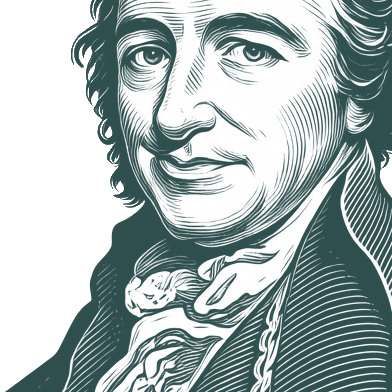
Thomas Paine (February 9, 1737 [O.S. January 29, 1736] – 8 June 1809) was a British-American political writer, theorist, and activist who had a great influence on the thoughts and ideas which led to the American Revolution and the United States Declaration of Independence. He wrote three of the most influential and controversial works of the 18th Century: Common Sense, Rights of Man, and The Age of Reason. His ideas reflected Enlightenment-era ideals of transnational human rights.
Biography information from
Wikiquote·
Portrait adapted from
Wikimedia Commons, Auguste Millière / After George Romney / After William Sharp (Public domain / CC0)
Though it is not a direct article of the christian system that this world that we inhabit is the whole of the habitable creation, yet it is so worked up therewith, from what is called the Mosaic account of the creation, the story of Eve and the apple, and the counterpart of that story, the death of the Son of God, that to believe otherwise, that is, to believe that God created a plurality of worlds, at least as numerous as what we call stars, renders the christian system of faith at once little and ridiculous; and scatters it in the mind like feathers in the air. The two beliefs can not be held together in the same mind; and he who thinks that be believes both, has thought but little of either.
...And, on the other hand, are we to suppose that every world in the boundless creation had an Eve, an apple, a serpent, and a redeemer? In this case, the person who is irreverently called the Son of God, and sometimes God himself, would have nothing else to do than to travel from world to world, in an endless succession of death, with scarcely a momentary interval of life.
The strength of one man is so unequal to his wants, and his mind so unfitted for perpetual solitude, that he is soon obliged to seek assistance and relief of another, who in his turn requires the same
Enhance Your Quote Experience
Enjoy ad-free browsing, unlimited collections, and advanced search features with Premium.
With respect to the books of the New Testament, particularly such parts as tell us of the resurrection and ascension of Christ, any person who could tell a story of an apparition, or of a man's walking, could have made such books; for the story is most wretchedly told.