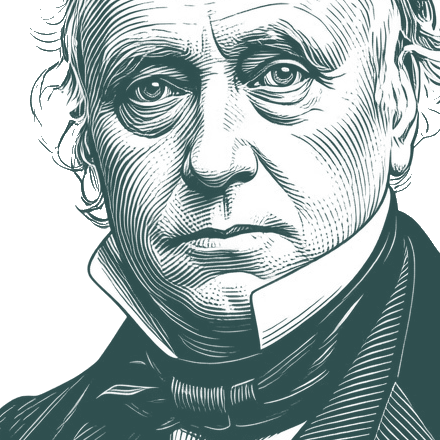
Our liberty is neither Greek nor Roman; but essentially English. It has a character of its own,—a character which has taken a tinge from the sentimen… - Thomas Babington Macaulay, 1st Baron Macaulay
""
Our liberty is neither Greek nor Roman; but essentially English. It has a character of its own,—a character which has taken a tinge from the sentiments of the chivalrous ages, and which accords with the peculiarities of our manners and of our insular situation. It has a language, too, of its own, and a language singularly idiomatic, full of meaning to ourselves, scarcely intelligible to strangers.
About
Thomas Babington Macaulay, 1st Baron Macaulay
Thomas Babington Macaulay, 1st Baron Macaulay (25 October 1800 – 28 December 1859) was a nineteenth century British poet, historian and Whig politician.
Additional quotes by Thomas Babington Macaulay, 1st Baron Macaulay
Many politicians of our time are in the habit of laying it down as a self-evident proposition, that no people ought to be free till they are fit to use their freedom. The maxim is worthy of the fool in the old story, who resolved not to go into the water till he had learned to swim. If men are to wait for liberty till they become wise and good in slavery, they may indeed have to wait forever.
The Vizier, he said, had invited the Government of Bengal to send him troops, and had promised to pay for them. The troops had been sent. How long the troops were to remain in Oude was a matter not settled by the treaty. It remained, therefore, to be settled between the contracting parties. But the contracting parties differed. Who then must decide? The stronger.
Try QuoteGPT
Chat naturally about what you need. Each answer links back to real quotes with citations.
Nevertheless the Scotch veterans not only pushed forward with great speed, but succeeded in carrying their artillery with them. They entered Lincolnshire, and were not far from Sleaford, when they learned that Ginkell with an irresistible force was close on their track.