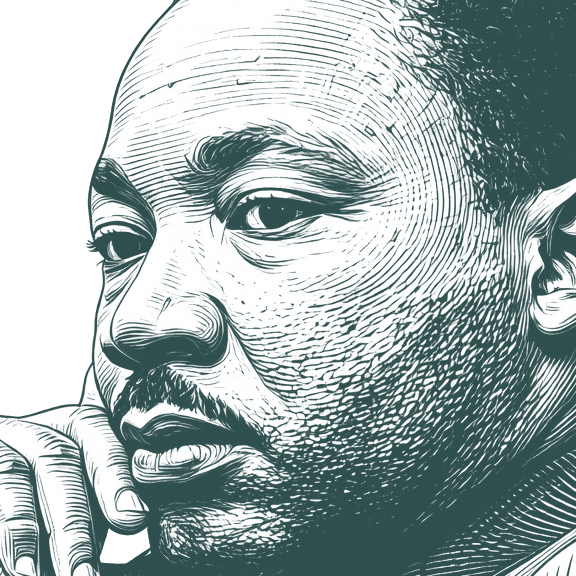
Dr. Martin Luther King Jr. (15 January 1929 – 4 April 1968) was an American Baptist minister, civil rights activist, and recipient of the Nobel Peace Prize of 1964. He was the husband of Coretta Scott King, and father of Yolanda King and Martin Luther King III.
Biography information from
Wikiquote·
Portrait adapted from
Wikimedia Commons, Yoichi Okamoto (Public domain / CC0)
Also Known As
Birth Name:
Michael King Jr.
Alternative Names:
Martin Luther King, Jr.
•
Dr. Martin Luther King, Jr.
•
Martin Luther King
•
Michael King
•
Dr. King
•
M. L. King
•
M.L. King
•
ML King
•
MLK
•
Martin Luther King Junior
•
Michael King Junior
•
Rev. Dr. Martin Luther King Jr.
•
The Rev. Dr. Martin Luther King Jr.
The surest way to be happy is to seek happiness for others.
Finally, the proper religious faith gives you this type of balance and this type of perspective that I'm talking about. This, you see, is something of the genius of great religion, that on the one hand, it gives man a sense of belonging and on the other hand, it gives him a sense of dependence on something higher. So he realizes that there is something beyond in which he lives and moves and even moves and gains his being. This is what great religion does for him.
PREMIUM FEATURE
Advanced Search Filters
Filter search results by source, date, and more with our premium search tools.
Every now and then I guess we all think realistically about that day when we will be victimized with what is life's final common denominator — that something we call death. We all think about it. And every now and then I think about my own death, and I think about my own funeral. And I don't think of it in a morbid sense. Every now and then I ask myself, "What is it that I would want said?" And I leave the word to you this morning. If any of you are around when I have to meet my day, I don't want a long funeral. And if you get somebody to deliver the eulogy, tell them not to talk too long. Every now and then I wonder what I want them to say. Tell them not to mention that I have a Nobel Peace Prize, that isn't important. Tell them not to mention that I have three or four hundred other awards, that's not important. Tell him not to mention where I went to school. I'd like somebody to mention that day, that Martin Luther King, Jr., tried to give his life serving others. I'd like for somebody to say that day, that Martin Luther King, Jr., tried to love somebody. I want you to say that day, that I tried to be right on the war question. I want you to be able to say that day that I did try to feed the hungry. I want you to be able to say that day that I did try in my life to clothe those who were naked. I want you to say, on that day, that I did try, in my life, to visit those who were in prison. I want you to say that I tried to love and serve humanity. Yes, if you want to say that I was a drum major, say that I was a drum major for justice; say that I was a drum major for peace; I was a drum major for righteousness. And all of the other shallow things will not matter. I won't have any money to leave behind. I won't have the fine and luxurious things of life to leave behind. But I just want to leave a committed life behind. And that's all I want to say.