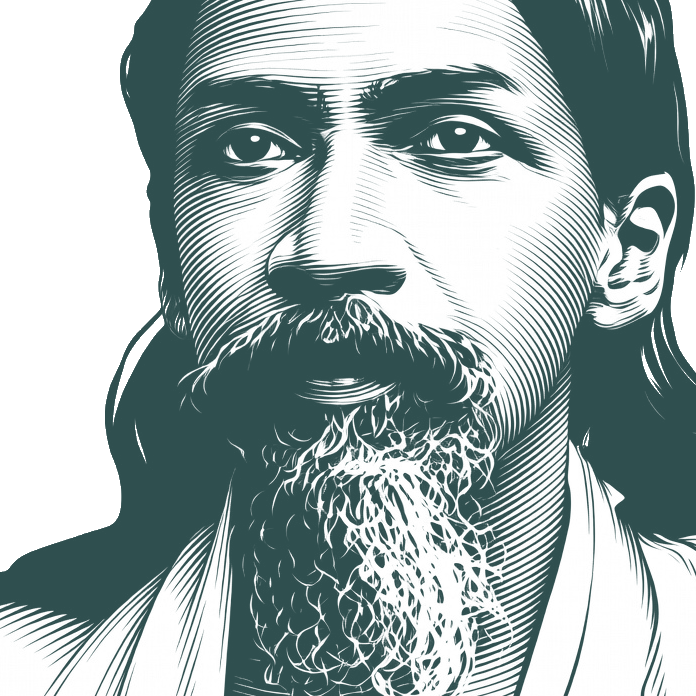
Sri Aurobindo [born Aravinda Akroyd Ghose] (15 August 1872 – 5 December 1950) was an Indian nationalist, scholar, poet, mystic, philosopher, yogi and guru, who developed concepts of human progress and spiritual evolution. With the help of his spiritual collaborator, Mirra Alfassa, he founded the Sri Aurobindo Ashram.
Biography information from
Wikiquote·
Portrait adapted from
Wikimedia Commons, Rudolf 1922 (Public domain / CC0)
Also Known As
Native Name:
অরবিন্দ ঘোষ
Alternative Names:
Sri Aurobindo Ghose
•
Sri Orobindo
•
Orobindo Ghosh
•
Shri Aurobindo
•
Aurobindo Ghose
•
Sri Aurobindo
•
Aurobindo
•
Aravinda Ackroyd Ghose
•
A.A.Ghosh
•
A.G.
•
Maharshi Aravind Babu
The complete use of pure reason brings us finally from physical to metaphysical knowledge. But the concepts of metaphysical knowledge do not in themselves fully satisfy the demand of our integral being. They are indeed entirely satisfactory to the pure reason itself, because they are the very stuff of its own existence. But our nature sees things through two eyes always, for it views them doubly as idea and as fact and therefore every concept is incomplete for us and to a part of our nature almost unreal until it becomes an experience.
But that immergence is not in the nature of an annihilation. Extinction is not the fulfilment of all this search and passion, suffering and rapture. The game would never have been begun if that were to be its ending.
You have spoken much today of my self-sacrifice and devotion to my country. I have heard that kind of speech ever since I came out of jail, but I hear it with embarrassment, with something of pain. For I know my weakness, I am a prey to my own faults and backslidings. I was not blind to them before and when they all rose up against me in seclusion, I felt them utterly. I knew them that I the man was a man of weakness, a faulty and imperfect instrument, strong only when a higher strength entered into me. Then I found myself among these young men and in many of them I discovered a mighty courage, a power of self-effacement in comparison with which I was simply nothing. I saw one or two who were not only superior to me in force and character, - very many were that, — but in the promise of that intellectual ability on which I prided myself.