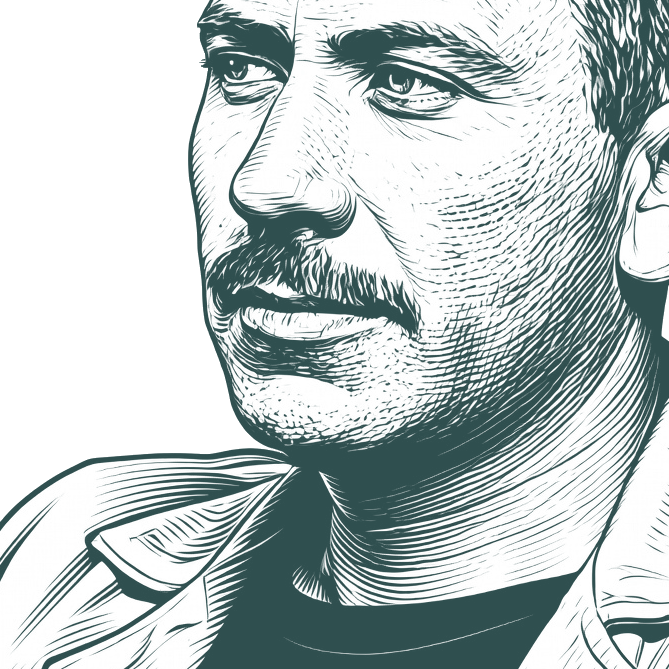
John Ernst Steinbeck Jr. (27 February 1902 – 20 December 1968) was an American writer. A recipient of the Nobel Prize for Literature in 1962, his works include the novella Of Mice and Men (1937) and the novel The Grapes of Wrath (1939, Pulitzer Prize for Fiction, 1940), both of which examine the lives of the working class and migrant workers during the Great Depression.
Biography information from
Wikiquote·
Portrait adapted from
Wikimedia Commons, McFadden Publications, Inc.; no photographer credited; photo likely the work of Sonya Noskowiak, as Steinbeck is wearing the same clothes from her 1935 studio session that produced the work shown here: https://www.si.edu/object/npg_NPG.2006.74 (Public domain / CC0)
Also Known As
Birth Name:
Jeffery Ernest Steinbeck
Alternative Names:
John Ernst Steinbeck, Jr.
•
John Ernst Steinbeck
•
John Ernest Steinbeck
•
John Ernst Steinbeck Jr
•
Steinbeck
Portrait from Wikimedia Commons. Credit: McFadden Publications, Inc.; no photographer credited; photo likely the work of Sonya Noskowiak, as Steinbeck is wearing the same clothes from her 1935 studio session that produced the work shown here: https://www.si.edu/object/npg_NPG.2006.74. Used under Public domain / CC0. Processed and styled by Quotewise.
Go Premium
Support Quotewise while enjoying an ad-free experience and premium features.
In March the soft rains continued, and each storm waited courteously until its predecessor sunk beneath the ground.
I guess we're all, or most of us, the wards of that nineteenth-century science which denied existence to anything it could not measure or explain. The things we couldn't explain went right on but surely not with our blessing. We did not see what we couldn't explain, and meanwhile a great part of the world was abandoned to children, insane people, fools, and mystics, who were more interested in what is than in why it is. So many old and lovely things are stored in the world's attic, because we don't want them around us and we don't dare throw them out.
"Not long ago, after my last trip to Russia, I had a conversation with an American very eminent in the field of politics. I asked what he read, and he replied that he studied history, sociology, politics and law.
"How about fiction - novels, plays poetry?" I asked.
"No," he said, "I have never had time for them. There's so much else I have to read."
I said, "Sir, I have recently visited Russia for the third time and don't know how well I understand Russians; but I do know that if I only read Russian history I could not have had the access to Russian thinking I have had from reading Dostoevsky, Tolstoy, Chekhov, Pushkin, Turgenev, Sholokhov, and Ehrenburg. History only recounts, with some inaccuracy, what they did. The fiction tells, or tries to tell, why they did it and what they felt and were like when they did it."
My friend nodded gravely. "I hadn't though of that," he said. "Yes, that might be so; I had always thought of fiction as opposed to fact."
But in considering the American past, how poor we would be in information without Huckleberry Fin, An American Tragedy, Winesburg, Ohio, Main Street, The Great Gatsby, and As I Lay Dying."