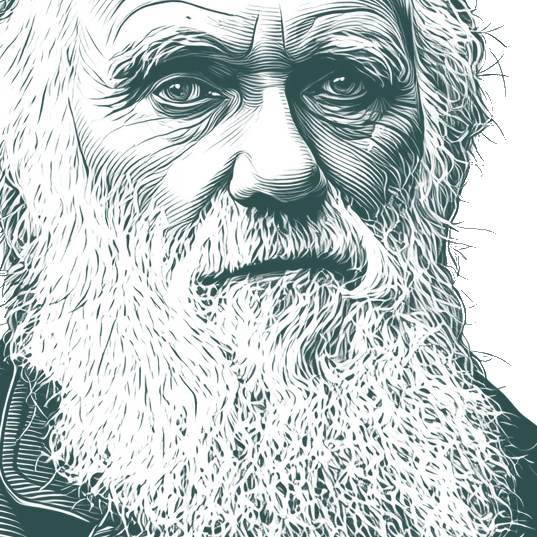
Con respecto a la creencia de que los seres orgánicos fueron creados hermosos para recreo del hombre (creencia que, se ha anunciado, derriba toda nue… - Charles Darwin
""
Con respecto a la creencia de que los seres orgánicos fueron creados hermosos para recreo del hombre (creencia que, se ha anunciado, derriba toda nuestra teoría) debemos primero hacer notar que
Charles Robert Darwin (12 February 1809 – 19 April 1882) was an English naturalist, geologist and biologist, best known for his contributions to the science of evolution. He proposed that evolution could be explained in part through natural and sexual selection. Prompted by awareness that Alfred Russel Wallace was developing similar theories he published his own sooner than he had originally intended. This theory is now an integral component of biological science.
Biography information from
Wikiquote·
Portrait adapted from
Wikimedia Commons, Herbert Rose Barraud (Public domain / CC0)
Also Known As
Birth Name:
Charles Robert Darwin
Alternative Names:
Charles R. Darwin
•
C. R. Darwin
•
Darwin
•
C.R. Darwin
•
CR Darwin
Amongst the half-human progenitors of man, and amongst savages, there have been struggles between the males during many generations for the possession of the females. But mere bodily strength and size would do little for victory, unless associated with courage, perseverance, and determined energy. With social animals, the young males have to pass through many a contest before they win a female, and the older males have to retain their females by renewed battles. They have, also, in the case of mankind, to defend their females, as well as their young, from enemies of all kinds, and to hunt for their joint subsistence. But to avoid enemies or to attack them with success, to capture wild animals, and to fashion weapons, requires the aid of the higher mental faculties, namely, observation, reason, invention, or imagination. These various faculties will thus have been continually put to the test and selected during manhood; they will, moreover, have been strengthened by use during this same period of life. Consequently, in accordance with the principle often alluded to, we might expect that they would at least tend to be transmitted chiefly to the male offspring at the corresponding period of manhood.
Unlimited Quote Collections
Organize your favorite quotes without limits. Create themed collections for every occasion with Premium.
The question of whether there exists a Creator and Ruler of the Universe has been answered in the affirmative by some of the highest intellects that have ever existed.