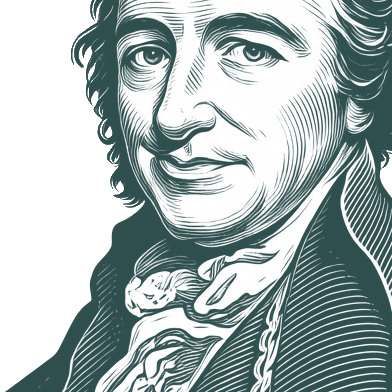
Titles are but nick-names, and every nickname is a title. The thing is perfectly harmless in itself, but it marks a sort of foppery in the human char… - Thomas Paine
""
Titles are but nick-names, and every nickname is a title. The thing is perfectly harmless in itself, but it marks a sort of foppery in the human character, which degrades it. It reduces man into the diminutive of man in things which are great, and the counterfeit of women in things which are little. It talks about its fine blue ribbon like a girl, and shows its new garter like a child. A certain writer, of some antiquity, says: "When I was a child, I thought as a child; but when I became a man, I put away childish things."
English
Collect this quote
About
Thomas Paine
Thomas Paine (February 9, 1737 [O.S. January 29, 1736] – 8 June 1809) was a British-American political writer, theorist, and activist who had a great influence on the thoughts and ideas which led to the American Revolution and the United States Declaration of Independence. He wrote three of the most influential and controversial works of the 18th Century: Common Sense, Rights of Man, and The Age of Reason. His ideas reflected Enlightenment-era ideals of transnational human rights.
Biography information from
Wikiquote·
Portrait adapted from
Wikimedia Commons, Auguste Millière / After George Romney / After William Sharp (Public domain / CC0)
Portrait from Wikimedia Commons. Credit: Auguste Millière / After George Romney / After William Sharp. Used under Public domain / CC0. Processed and styled by Quotewise.
Go Premium
Support Quotewise while enjoying an ad-free experience and premium features.
Separated from the rest of Europe, she has contracted an unsocial habit of manners, and imagines in others the jealousy she creates in herself. never long satisfied with peace, she supposes the discontent universal, and buoyed up with her own importance, conceives herself the only object pointed at. The expression has been often used, and always with a fraudulent design; for when the idea of a natural enemy is conceived, it prevents all other inquiries and the real cause of the quarrel is hidden in the universality of the conceit. Men start at the notion of a natural enemy, and ask no other question. The cry obtains credit like the alarm of a mad dog, and is one of those kind of tricks, which, by operating on the common passions, secures their interest through their folly.
It was the cause of America that made me an author. The force with which it struck my mind and the dangerous condition the country appeared to me in, by courting an impossible and an unnatural reconciliation with those who were determined to reduce her, instead of striking out into the only line that could cement and save her, A Declaration Of Independence, made it impossible for me, feeling as I did, to be silent: and if, in the course of more than seven years, I have rendered her any service, I have likewise added something to the reputation of literature, by freely and disinterestedly employing it in the great cause of mankind, and showing that there may be genius without prostitution. Independence always appeared to me practicable and probable, provided the sentiment of the country could be formed and held to the object: and there is no instance in the world, where a people so extended, and wedded to former habits of thinking, and under such a variety of circumstances, were so instantly and effectually pervaded, by a turn in politics, as in the case of independence; and who supported their opinion, undiminished, through such a succession of good and ill fortune, till they crowned it with success. But as the scenes of war are closed, and every man preparing for home and happier times, I therefore take my leave of the subject. I have most sincerely followed it from beginning to end, and through all its turns and windings: and whatever country I may hereafter be in, I shall always feel an honest pride at the part I have taken and acted, and a gratitude to nature and providence for putting it in my power to be of some use to mankind.
PREMIUM FEATURE
Advanced Search Filters
Filter search results by source, date, and more with our premium search tools.
The continually progressive change to which the meaning of words is subject, the want of a universal language which renders translation necessary, the errors to which translations are again subject, the mistakes of copyists and printers, together with the possibility of willful alteration, are of themselves evidences that human language, whether in speech or in print, cannot be the vehicle of the Word of God.-The Word of God exists in something else.