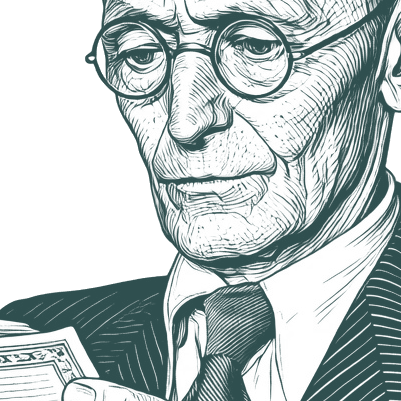
I called the world of phenomena an illusion, I called my eyes and my tongue and accident, valueless phenomena. No, that is all over; I have awakened,… - Hermann Hesse
""
I called the world of phenomena an illusion, I called my eyes and my tongue and accident, valueless phenomena. No, that is all over; I have awakened, I have really awakened and have just been born today.
Hermann Karl Hesse (2 July 1877 – 9 August 1962) was a German-Swiss poet, novelist, and painter. In 1946, he received the Nobel Prize in Literature. His most famous works include Steppenwolf, Siddhartha, and The Glass Bead Game (also known as Magister Ludi) all of which explore an individual's search for spirituality.
‘I am not that wanton whose feet you stroked beneath the table. You seem only to know such women as that.’ ‘No, God be praised, you are far more beautiful, and finer.’ ‘That was not what I meant’ ‘No, but it is so. Do you know how beautiful you are?’ ‘I have my looking-glass.’ ‘Did you ever look and see your forehead in it, Lydia? And your shoulders and your little finger-nails; and then your knees? And have you seen how all these things belong to each other, how all has the same long, beautiful shape? Have you seen it?’ Ch IX
For there is not a single human being, not even the primitive Negro, not even the idiot, who is so conveniently simple that his being can be explained as the sum of two or three principal elements; and to explain so complex a man as Harry by the artless division into wolf and man is a hopelessly childish attempt. Harry consists of a hundred or a thousand selves, not of two. His life oscillates, as everyone's does, not merely between two poles, such as the body and the spirit, the saint and the sinner, but between thousand and thousands.
Enhance Your Quote Experience
Enjoy ad-free browsing, unlimited collections, and advanced search features with Premium.
Among the many worlds which man did not receive as a gift of nature, but which he created with his own mind, the world of books is the greatest. Every child, scrawling his first letters on his slate and attempting to read for the first time, in so doing, enters an artificial and complicated world; to know the laws and rules of this world completely and to practice them perfectly, no single human life is long enough. Without words, without writing, and without books there would be no history, there could be no concept of humanity. And if anyone wants to try to enclose in a small space in a single house or single room, the history of the human spirit and to make it his own, he can only do this in the form of a collection of books.