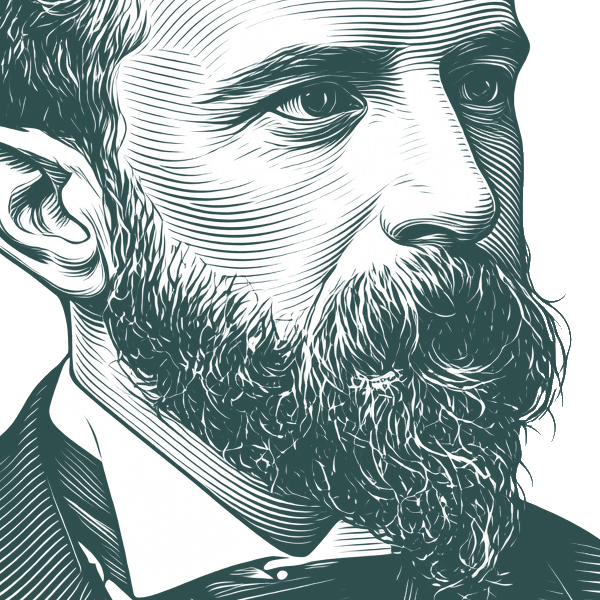
Adams proclaimed that in the last synthesis, order and anarchy were one, but that the unity was chaos. As anarchist, conservative and Christian, he h… - Henry Adams
""
Adams proclaimed that in the last synthesis, order and anarchy were one, but that the unity was chaos. As anarchist, conservative and Christian, he had no motive or duty but to attain the end; and, to hasten it, he was bound to accelerate progress; to concentrate energy; to accumulate power; to multiply and intensify forces; to reduce friction, increase velocity and magnify momentum, partly because this was the mechanical law of the universe as science explained it; but partly also in order to get done with the present which artists and some others complained of; and finally — and chiefly — because a rigorous philosophy required it, in order to penetrate the beyond, and satisfy man's destiny by reaching the largest synthesis in its ultimate contradiction. Of course the untaught critic instantly objected that this scheme was neither conservative, Christian, nor anarchic, but such objection meant only that the critic should begin his education in any infant school in order to learn that anarchy which should be logical would cease to be anarchic. To the conservative Christian anarchist, the amiable doctrines of Kropotkin were sentimental ideas of Russian mental inertia covered with the name of anarchy merely to disguise their innocence.
English
Collect this quote
About
Henry Adams
Henry Brooks Adams (16 February 1838 – 27 March 1918) was a U.S. historian, journalist, novelist and educator. He was the great-grandson of John Adams, grandson of John Quincy Adams and son of Charles Francis Adams, Sr.
Biography information from
Wikiquote·
Portrait adapted from
Wikimedia Commons, William Notman (Public domain / CC0)
As long as he could whisper, he would go on as he had begun, bluntly refusing to meet his creator with the admission that the creation had taught him nothing except that the square of the hypotenuse of a right-angled triangle might for convenience be taken as equal to something else. Every man with self-respect enough to become effective, if only as a machine, has had to account to himself for himself somehow, and to invent a formula of his own for his universe, if the standard formulas failed.
He took their facts for granted. He knew no more than a firefly about rays — or about race or sex — or ennui — or a bar of music — or a pang of love — or a grain of musk — or of phosphorus — or conscience — or duty — or the force of Euclidian geometry — or non-Euclidian — or heat — or light — or osmosis — or electrolysis — or the magnet — or ether — or vis inertiae — or gravitation — or cohesion — or elasticity — or surface tension — or capillary attraction — or Brownian motion — or of some scores, or thousands, or millions of chemical attractions, repulsions or indifferences which were busy within and without him; or, in brief, of Force itself, which, he was credibly informed, bore some dozen definitions in the textbooks, mostly contradictory, and all, as he was assured, beyond his intelligence.
Works in ChatGPT, Claude, or Any AI
Add semantic quote search to your AI assistant via MCP. One command setup.
Like so many other great observers, Langley was not a mathematician, and like most physicists, he believed in physics. Rigidly denying himself the amusement of philosophy, which consists chiefly in suggesting unintelligible answers to insoluble problems, he still knew the problems, and liked to wander past them in a courteous temper, even bowing to them distantly as though recognising their existence though doubting their respectability.