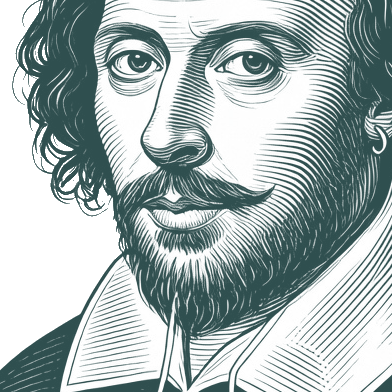
William Shakespeare (26 April 1564 (baptised) – 23 April 1616) was an English poet, playwright, and actor, widely regarded as the greatest writer in the English language and the world's pre-eminent dramatist.
Biography information from
Wikiquote·
Portrait adapted from
Wikimedia Commons, Attributed to John Taylor (Public domain / CC0)
Also Known As
Also Known As:The Bard of Avon
Alternative Names:
The Bard
•
Swan of Avon
•
Bard of Avon
•
Shakespeare
•
William Shakspere
•
Shakespere
•
Shakespear
•
Shakspeare
•
Shackspeare
•
Shakspere
•
William Shakspeare
•
William Shake‐speare
•
William Shak‐ſpeare
•
William Shake-speare
•
William Shak-ſpeare
WESTMORELAND. O that we now had here But one ten thousand of those men in England That do no work to-day!
KING. What's he that wishes so? My cousin Westmoreland? No, my fair cousin; If we are mark'd to die, we are enow To do our country loss; and if to live, The fewer men, the greater share of honour. God's will! I pray thee, wish not one man more. By Jove, I am not covetous for gold, Nor care I who doth feed upon my cost; It yearns me not if men my garments wear; Such outward things dwell not in my desires. But if it be a sin to covet honour, I am the most offending soul alive. No, faith, my coz, wish not a man from England. God's peace! I would not lose so great an honour As one man more methinks would share from me For the best hope I have. O, do not wish one more! Rather proclaim it, Westmoreland, through my host, That he which hath no stomach to this fight, Let him depart; his passport shall be made, And crowns for convoy put into his purse; We would not die in that man's company That fears his fellowship to die with us. This day is call'd the feast of Crispian. He that outlives this day, and comes safe home, Will stand a tip-toe when this day is nam'd, And rouse him at the name of Crispian. He that shall live this day, and see old age, Will yearly on the vigil feast his neighbours, And say 'To-morrow is Saint Crispian.' Then will he strip his sleeve and show his scars, And say 'These wounds I had on Crispian's day.' Old men forget; yet all shall be forgot, But he'll remember, with advantages, What feats he did that day. Then shall our names, Familiar in his mouth as household words- Harry the King, Bedford and Exeter, Warwick and Talbot, Salisbury and Gloucester- Be in their flowing cups freshly rememb'red. This story shall the good man teach his son; And Crispin Crispian shall ne'er go by, From this day to the ending of the world, But we in it shall be remembered- We few, we happy few, we band of brothers; For he to-day that sheds his blood with me Shall be
Two households, both alike in dignity, In fair Verona, where we lay our scene, From ancient grudge break to new mutiny, Where civil blood makes civil hands unclean. From forth the fatal loins of these two foes A pair of star-cross'd lovers take their life; Whole misadventured piteous overthrows Do with their death bury their parents' strife. The fearful passage of their death-mark'd love, And the continuance of their parents' rage, Which, but their children's end, nought could remove, Is now the two hours' traffic of our stage; The which if you with patient ears attend, What here shall miss, our toil shall strive to mend.
Go Premium
Support Quotewise while enjoying an ad-free experience and premium features.