The civilised labourer who gives his best effort for a bit of bread, who builds a palace and sleeps in a stable, who weaves rich fabrics and dresses … - Pierre-Joseph Proudhon
""
The civilised labourer who gives his best effort for a bit of bread, who builds a palace and sleeps in a stable, who weaves rich fabrics and dresses in rags, and who produces everything and does without everything, is not free.
Pierre-Joseph Proudhon (pronounced [ˈpruːd.ɒn] in BrE, [pʁu.dɔ̃] in French) (15 January 1809 – 19 January 1865) was the first individual to call himself an "anarchist," and the first documented as using the word "Capitalist" to mean property-owner.
Biography information from
Wikiquote·
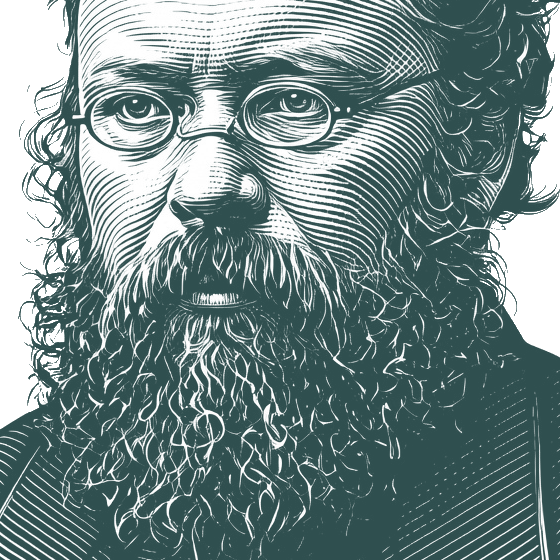
Portrait adapted from
Wikimedia Commons, Nadar (Public domain / CC0)
Also Known As
Alternative Names:
P.-J. Proudhon
•
Pierre Joseph Proudhon
•
Purūdon
•
Pʻu-lu-tung
•
Pʹer Zhozef Prudon
All my economic ideas as developed over twenty-five years can be summed up in the words: agricultural-industrial federation. All my political ideas boil down to a similar formula: political federation or decentralization.
The purchaser draws boundaries, fences himself in, and says, “This is mine; each one by himself, each one for himself.” Here, then, is a piece of land upon which, henceforth, no one has a right to step, save the proprietor and his friends; which can benefit nobody, save the proprietor and his servants. Let these sales multiply, and soon the people — who have been neither able nor willing to sell, and who have received none of the proceeds of the sale — will have nowhere to rest, no place of shelter, no ground to till. They will die of hunger at the proprietor's door, on the edge of that property which was their birthright; and the proprietor, watching them die, will exclaim, “So perish idlers and vagrants!”
Enhance Your Quote Experience
Enjoy ad-free browsing, unlimited collections, and advanced search features with Premium.
I protest that in criticizing property, or rather the whole mass of institutions of which property is the pivot, I have never intended either to attack individual rights, based upon existing laws, or to contest the legitimacy of acquired possessions, or to demand an arbitrary division of goods, or to place any obstacle to the free and regular acquisition, by sale and exchange, of property, or even to forbid or suppress, by sovereign degree, ground rent and interest on capital.
I think that all these manifestations of human activity should remain free and voluntary for all: I ask for them no modifications, restrictions or suppressions, other than those which result naturally and of necessity from the universalisation of the principle of reciprocity which I propose.