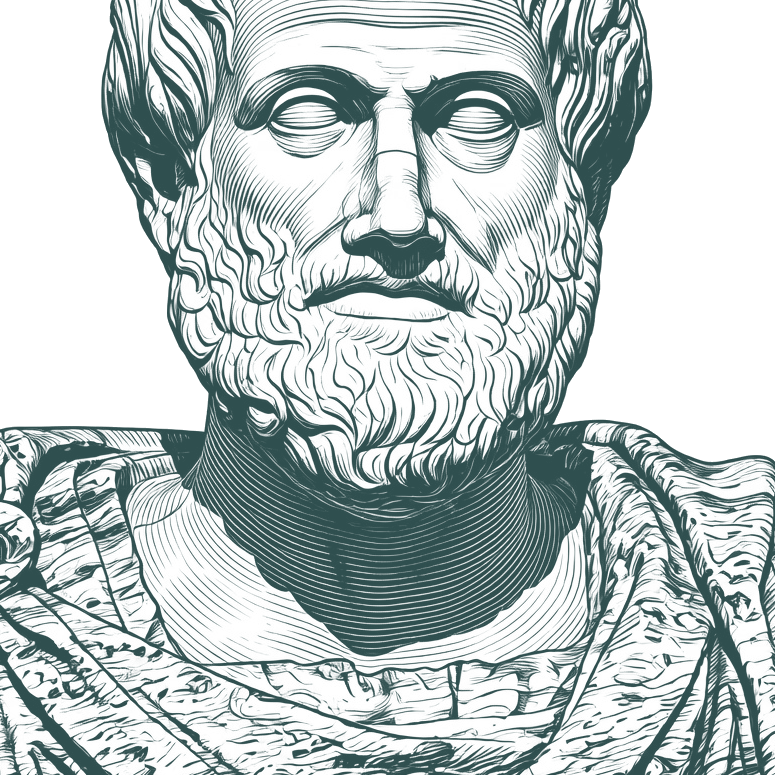
If a man knows what it is right to do, he does not require a formal reason. And a person that has been thus trained, either possesses these first pri… - Aristotle
""
If a man knows what it is right to do, he does not require a formal reason. And a person that has been thus trained, either possesses these first principles already, or can easily acquire them. (Bk I, Ch II)
Aristotle (Ἀριστοτέλης Aristotelēs; 384 BC – 322 BC) was a Greek philosopher and polymath during the Classical period in Ancient Greece. Taught by Plato, he was the teacher of Theophrastus and founder of the Lyceum, the Peripatetic school of philosophy, and the Aristotelian tradition. His writings cover many subjects including physics, biology, zoology, metaphysics, logic, ethics, aesthetics, poetry, theatre, music, rhetoric, psychology, linguistics, economics, politics, meteorology, geology and government. Aristotle provided a complex synthesis of the various philosophies existing prior to him. It was above all from his teachings that the West inherited its intellectual lexicon, as well as problems and methods of inquiry. As a result, his philosophy has exerted a unique influence on almost every form of knowledge in the West and it continues to be a subject of contemporary philosophical discussion.
Biography information from
Wikiquote·
Portrait adapted from
Wikimedia Commons, After Lysippos (Public domain / CC0)
Also Known As
Native Name:
Ἀριστοτέλης
Alternative Names:
the Stagirite
•
Aristotelis
•
Aristoteles
Though we love both the truth and our friends, reverence is due to the truth first.
It is this simplicity that makes the uneducated more effective than the educated when addressing popular audiences — makes them, as the poets tell us, 'charm the crowd's ears more finely.' Educated men lay down broad general principles; uneducated men argue from common knowledge and draw obvious conclusions.
Try QuoteGPT
Chat naturally about what you need. Each answer links back to real quotes with citations.
Rhetoric is the counterpart of Dialectic. Both alike are concerned with such things as come, more or less, within the general ken of all men and belong to no definite science. Accordingly, all men make use, more or less, of both; for to a certain extent all men attempt to discuss statements and to maintain them, to defend themselves and to attack others.