When men advocate the rights of conscience, they in no sense mean the rights of the Creator, nor the duty to Him, in thought and deed, of the creatur… - John Henry Newman
""
When men advocate the rights of conscience, they in no sense mean the rights of the Creator, nor the duty to Him, in thought and deed, of the creature; but the right of thinking, speaking, writing, and acting, according to their judgment or their humour, without any thought of God at all. They do not even pretend to go by any moral rule, but they demand, what they think is an Englishman's prerogative, to be his own master in all things, and to profess what he pleases, asking no one's leave, and accounting priest or preacher, speaker or writer, unutterably impertinent, who dares to say a word against his going to perdition, if he like it, in his own way. Conscience has rights because it has duties; but in this age, with a large portion of the public, it is the very right and freedom of conscience to dispense with conscience, to ignore a Lawgiver and Judge, to be independent of unseen obligations. It becomes a license to take up any or no religion, to take up this or that and let it go again, to go to Church, to go to chapel, to boast of being above all religions and to be an impartial critic of each of them. Conscience is a stern monitor, but in this century it has been superseded by a counterfeit, which the eighteen centuries prior to it never heard of, and could not have mistaken for it, if they had. It is the right of self-will.
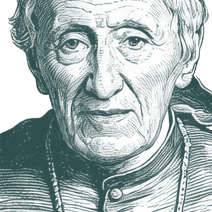
Saint John Henry Cardinal Newman (21 February 1801 – 11 August 1890) was an English convert to Catholicism, later made a cardinal.
Portrait adapted from
Wikimedia Commons, John Everett Millais (Public domain / CC0)
Also Known As
Alternative Names:
Cardinal Newman
•
Blessed John Henry Newman
•
Catholicus
•
John Henry, Cardinal Newman
•
Cardinal John Henry Newman
•
Saint John Newman
•
John H. Newman
[T]here is much in the liberalistic theory which is good and true; for example, not to say more, the precepts of justice, truthfulness, sobriety, self-command, benevolence, which, as I have already noted are among its avowed principles, and the natural laws of society. It is not till we find that this array of principles is intended to supersede, to block out, religion, that we pronounce it to be evil. There never was a device of the Enemy, so cleverly framed, and with such promise of success.
There is a knowledge which is desirable, though nothing come of it, as being of itself a treasure, and a sufficient remuneration of years of labor.
We are told that God has spoken. Where? In a book? We have tried it, and it disappoints; it disappoints, that most holy and blessed gift, not from fault of its own, but because it is used for a purpose for which it was not given. The Ethiopian's reply, when St. Philip asked him if he understood what he was reading, is the voice of nature; "How can I, unless some man shall guide me?" The Church undertakes that office; she does what none else can do, and this is the secret of the power.