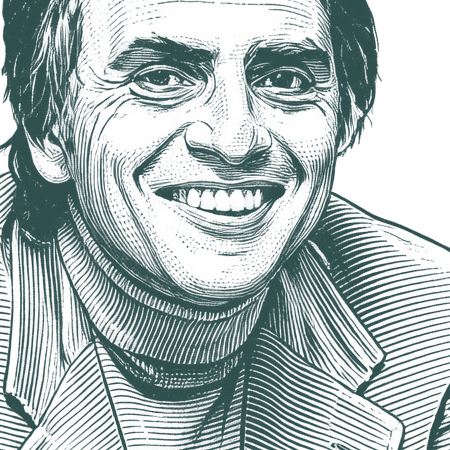
I try not to think with my gut. If I'm serious about understanding the world, thinking with anything besides my brain, as tempting as that might be, … - Carl Sagan
""
I try not to think with my gut. If I'm serious about understanding the world, thinking with anything besides my brain, as tempting as that might be, is likely to get me in trouble. Really, it's okay to reserve judgment until the evidence is in.
Carl Edward Sagan (9 November 1934 – 20 December 1996) was an American astronomer, planetary scientist, cosmologist, astrophysicist, astrobiologist, author, and science communicator. His best known scientific contribution is research on extraterrestrial life, including experimental demonstration of the production of amino acids from basic chemicals by radiation. Sagan assembled the first physical messages sent into space, the Pioneer plaque and the Voyager Golden Record, universal messages that could potentially be understood by any extraterrestrial intelligence that might find them. Sagan argued the hypothesis, accepted since, that the high surface temperatures of Venus can be attributed to, and calculated using, the greenhouse effect. He testified to the US Congress in 1985 that the greenhouse effect will change the earth's climate system.
Biography information from
Wikiquote·
Portrait adapted from
Wikimedia Commons, NASA/JPL (Public domain / CC0)
Also Known As
Native Name:
Carl Edward Sagan
Alternative Names:
Sagan
•
Carl E. Sagan
•
Carl E Sagan
•
C. E. Sagan
•
C.E. Sagan
•
C E Sagan
•
C. Sagan
•
C Sagan
•
Sagan C
•
Sagan C.
•
Sagan C. E.
•
Sagan CE
A statement: children who watch violent TV programmes tend to be more violent when they grow up. But did the TV cause the violence, or do violent children preferentially enjoy watching violent programmes? Very likely both are true. Commercial defenders of TV violence argue that anyone can distinguish between television and reality. But Saturday morning children’s programmes now average 25 acts of violence per hour. At the very least this desensitizes young children to aggression and random cruelty. And if impressionable adults can have false memories implanted in their brains, what are we implanting in our children when we expose them to some 100,000 acts of violence before they graduate from elementary school?
The candle flame gutters. Its little pool of light trembles. Darkness gathers. The demons begin to stir.
I know that the consequences of scientific illiteracy are far more dangerous in our time than in any that has come before. It’s perilous and foolhardy for the average citizen to remain ignorant about global warming, say, or ozone depletion, air pollution, toxic and radioactive wastes, acid rain, topsoil erosion, tropical deforestation, exponential population growth. Jobs and wages depend on science and technology. If our nation can’t manufacture, at high quality and low price, products people want to buy, then industries will continue to drift away and transfer a little more prosperity to other parts of the world. Consider the social ramifications of fission and fusion power, supercomputers, data “highways,” abortion, radon, massive reductions in strategic weapons, addiction, government eavesdropping on the lives of its citizens, high-resolution TV, airline and airport safety, fetal tissue transplants, health costs, food additives, drugs to ameliorate mania or depression or schizophrenia, animal rights, superconductivity, morning-after pills, alleged hereditary antisocial predispositions, space stations, going to Mars, finding cures for AIDS and cancer. How can we affect national policy — or even make intelligent decisions in our own lives — if we don’t grasp the underlying issues? As I write, Congress is dissolving its own Office of Technology Assessment — the only organization specifically tasked to provide advice to the House and Senate on science and technology. Its competence and integrity over the years have been exemplary. Of the 535 members of the U.S. Congress, rarely in the twentieth century have as many as one percent had any significant background in science. The last scientifically literate President may have been Thomas Jefferson.* So how do Americans decide these matters? How do they instruct their representatives? Who in fact makes these decisions, and on what basis? —