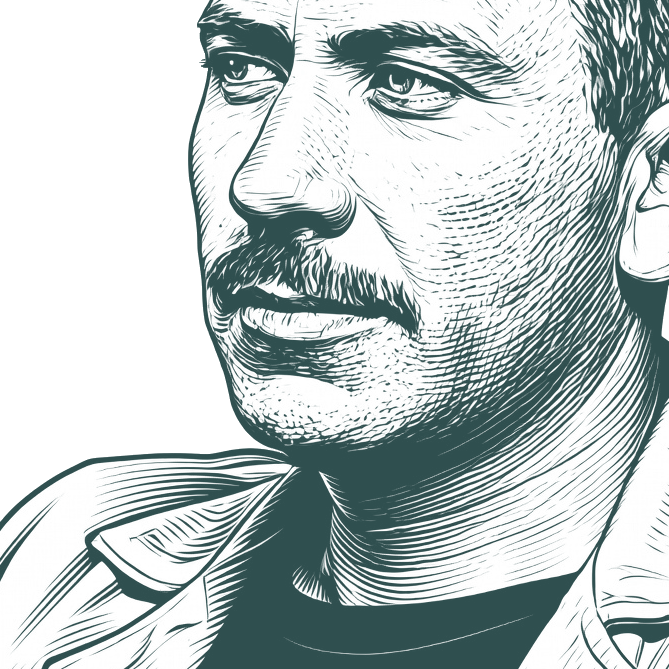
John Ernst Steinbeck Jr. (27 February 1902 – 20 December 1968) was an American writer. A recipient of the Nobel Prize for Literature in 1962, his works include the novella Of Mice and Men (1937) and the novel The Grapes of Wrath (1939, Pulitzer Prize for Fiction, 1940), both of which examine the lives of the working class and migrant workers during the Great Depression.
Biography information from
Wikiquote·
Portrait adapted from
Wikimedia Commons, McFadden Publications, Inc.; no photographer credited; photo likely the work of Sonya Noskowiak, as Steinbeck is wearing the same clothes from her 1935 studio session that produced the work shown here: https://www.si.edu/object/npg_NPG.2006.74 (Public domain / CC0)
Also Known As
Birth Name:
Jeffery Ernest Steinbeck
Alternative Names:
John Ernst Steinbeck, Jr.
•
John Ernst Steinbeck
•
John Ernest Steinbeck
•
John Ernst Steinbeck Jr
•
Steinbeck
Portrait from Wikimedia Commons. Credit: McFadden Publications, Inc.; no photographer credited; photo likely the work of Sonya Noskowiak, as Steinbeck is wearing the same clothes from her 1935 studio session that produced the work shown here: https://www.si.edu/object/npg_NPG.2006.74. Used under Public domain / CC0. Processed and styled by Quotewise.
Go Premium
Support Quotewise while enjoying an ad-free experience and premium features.
Any man of reasonable intelligence can make money if that's what he wants. Mostly it's women or clothes or admiration he really wants and they deflect him.
There's an awful lot of inactive kindness which is nothing but laziness, not wanting any trouble, confusion, or effort.
Try QuoteGPT
Chat naturally about what you need. Each answer links back to real quotes with citations.
A child may ask, “What is the world’s story about?” And a grown man or woman may wonder, “What way will the world go? How does it end and, while we’re at it, what’s the story about?” I believe that there is one story in the world, and only one, that has frightened and inspired us, so that we live in a Pearl White serial of continuing thought and wonder. Humans are caught — in their lives, in their thoughts, in their hungers and ambitions, in their avarice and cruelty, and in their kindness and generosity too — in a net of good and evil. I think this is the only story we have and that it occurs on all levels of feeling and intelligence. Virtue and vice were warp and woof of our first consciousness, and they will be the fabric of our last, and this despite any changes we may impose on field and river and mountain, on economy and manners. There is no other story. A man, after he has brushed off the dust and chips of his life, will have left only the hard, clean questions: Was it good or was it evil? Have I done well — or ill?