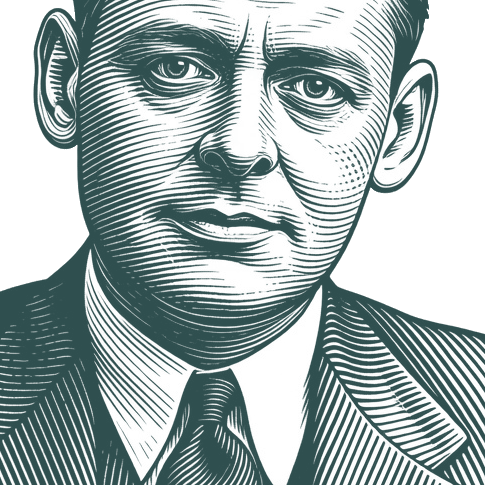
Thomas Stearns Eliot (26 September 1888 – 4 January 1965) was an American-born English poet, dramatist and literary critic. Noted for spiritual and religious themes in many of his poems, he converted from Unitarianism to Anglicanism in 1927.
Biography information from
Wikiquote·
Portrait adapted from
Wikimedia Commons, Thomas Stearns Eliot with his sister and his cousin by Lady Ottoline Morrell.jpg: Lady Ottoline Morrell (1873–1938) derivative work: Octave.H (Public domain / CC0)
Also Known As
Birth Name:
Thomas Stearns Eliot
Alternative Names:
Eliot
•
T S Eliot
•
Thomas Eliot
•
T.S. Eliot
Portrait from Wikimedia Commons. Credit: Thomas Stearns Eliot with his sister and his cousin by Lady Ottoline Morrell.jpg: Lady Ottoline Morrell (1873–1938) derivative work: Octave.H. Used under Public domain / CC0. Processed and styled by Quotewise.
PREMIUM FEATURE
Advanced Search Filters
Filter search results by source, date, and more with our premium search tools.
What we call the beginning is often the end And to make and end is to make a beginning. The end is where we start from. And every phrase And sentence that is right (where every word is at home, Taking its place to support the others, The word neither diffident nor ostentatious, An easy commerce of the old and the new, The common word exact without vulgarity, The formal word precise but not pedantic, The complete consort dancing together) Every phrase and every sentence is an end and a beginning, Every poem an epitaph. And any action Is a step to the block, to the fire, down the sea's throat Or to an illegible stone: and that is where we start. We die with the dying: See, they depart, and we go with them. We are born with the dead: See, they return, and bring us with them. The moment of the rose and the moment of the yew-tree Are of equal duration. A people without history Is not redeemed from time, for history is a pattern Of timeless moments. So, while the light fails On a winter's afternoon, in a secluded chapel History is now and England.