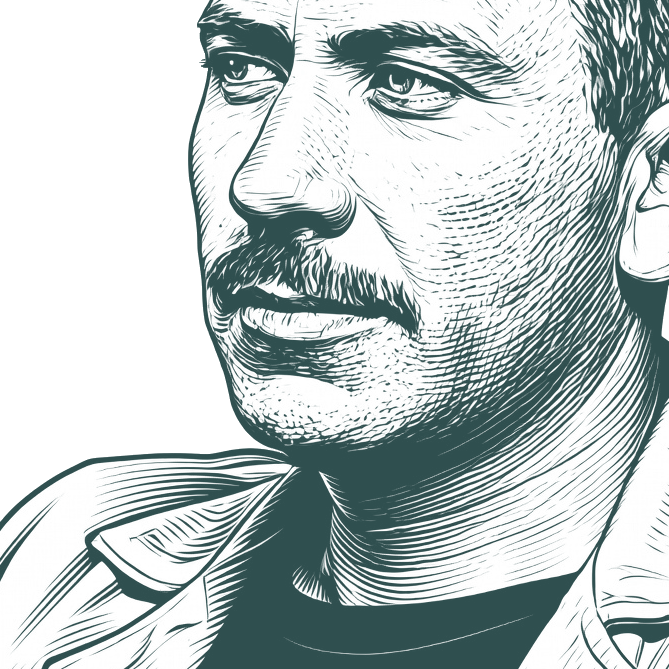
It seems to me that man has engaged in a blind and fearful struggle out of a past he can't remember, into a future he can't foresee nor understand. A… - John Steinbeck
""
It seems to me that man has engaged in a blind and fearful struggle out of a past he can't remember, into a future he can't foresee nor understand. And man has met and defeated every obstacle, every enemy except one. He cannot win over himself. How mankind hates himself.
John Ernst Steinbeck Jr. (27 February 1902 – 20 December 1968) was an American writer. A recipient of the Nobel Prize for Literature in 1962, his works include the novella Of Mice and Men (1937) and the novel The Grapes of Wrath (1939, Pulitzer Prize for Fiction, 1940), both of which examine the lives of the working class and migrant workers during the Great Depression.
Biography information from
Wikiquote·
Portrait adapted from
Wikimedia Commons, McFadden Publications, Inc.; no photographer credited; photo likely the work of Sonya Noskowiak, as Steinbeck is wearing the same clothes from her 1935 studio session that produced the work shown here: https://www.si.edu/object/npg_NPG.2006.74 (Public domain / CC0)
Also Known As
Birth Name:
Jeffery Ernest Steinbeck
Alternative Names:
John Ernst Steinbeck, Jr.
•
John Ernst Steinbeck
•
John Ernest Steinbeck
•
John Ernst Steinbeck Jr
•
Steinbeck
Portrait from Wikimedia Commons. Credit: McFadden Publications, Inc.; no photographer credited; photo likely the work of Sonya Noskowiak, as Steinbeck is wearing the same clothes from her 1935 studio session that produced the work shown here: https://www.si.edu/object/npg_NPG.2006.74. Used under Public domain / CC0. Processed and styled by Quotewise.
PREMIUM FEATURE
Advanced Search Filters
Filter search results by source, date, and more with our premium search tools.
Ain’t many guys travel around together,” he mused. “I don’t know why. Maybe ever’body in the whole damn world is scared of each other.
He thought dawdling, protective thoughts, sitting under the lamp, but he knew that pretty soon his name would be called and he would have to go up before the bench with himself as judge and his own crimes as jurors.
And his name was called, shrilly in his ears. His mind walked in to face the accusers: Vanity, which charged him with being ill dressed and dirty and vulgar; and Lust, slipping him the money for his whoring; Dishonesty, to make him pretend to talent and thought he did not have; Laziness and Gluttony arm in arm. Tom felt comforted by these because they screened the great Gray One in the back seat, waiting — the gray and dreadful crime. He dredged up lesser things, used small sins almost like virtues to save himself. There were Covetousness of Will’s money, Treason toward his mother’s God, Theft of time and hope, sick Rejection of love.
Samuel spoke softly but his voice filled the room. “Be good, be pure, be great, be Tom Hamilton.”
Tom ignored his father. He said, “I’m busy greeting my friends,” and he nodded to Discourtesy and Ugliness and Unfilial Conduct and Unkempt Fingernails. Then he started with Vanity again. The Gray One shouldered up in front. It was too late to stall with baby sins. This Gray One was Murder.
Unlimited Quote Collections
Organize your favorite quotes without limits. Create themed collections for every occasion with Premium.
"The Western States nervous under the beginning change. Texas and Oklahoma, Kansas and Arkansas, New Mexico, Arizona, California. A single family moved from the land. Pa borrowed money from the bank, and now the bank wants the land. The land company — that's the bank when it has land — wants tractors, not families on the land. Is a tractor bad? Is the power that turns the long furrows wrong? If this tractor were ours it would be good — not mine, but ours. If our tractor turned the long furrows of our land, it would be good. Not my land, but ours. We could love that tractor then as we have loved this land when it was ours. But the tractor does two things — it turns the land and turns us off the land. There is little difference between this tractor and a tank. The people are driven, intimidated, hurt by both. We must think about this.
One man, one family driven from the land; this rusty car creaking along the highway to the west. I lost my land, a single tractor took my land. I am alone and bewildered. And in the night one family camps in a ditch and another family pulls in and the tents come out. The two men squat on their hams and the women and children listen. Here is the node, you who hate change and fear revolution. Keep these two squatting men apart; make them hate, fear, suspect each other. Here is the anlarge of the thing you fear. This is the zygote. For here "I lost my land" is changed; a cell is split and from its splitting grows the thing you hate — "We lost our land." The danger is here, for two men are not as lonely and perplexed as one. And from this first "we" there grows a still more dangerous thing: "I have a little food" plus "I have none." If from this problem the sum is "We have a little food," the thing is on its way, the movement has direction. Only a little multiplication now, and this land, this tractor are ours. The two men squatting in a ditch, the little fire, the side- meat stewing in a single pot, the silent, stone-eyed women; behind, th