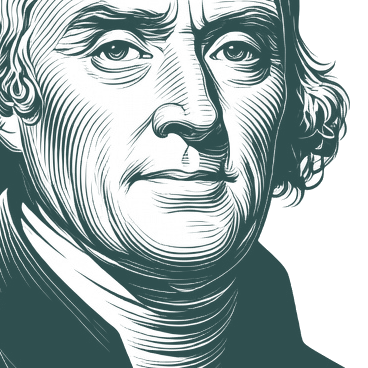
Thomas Jefferson (13 April 1743 – 4 July 1826) was author of the Declaration of Independence (1776) and the Virginia Statute for Religious Freedom (1777), founder of the University of Virginia (1819), the third president of the United States (1801–1809), a political philosopher, editor of Jefferson's Bible (1819), and one of the most influential founders of the United States.
Biography information from
Wikiquote·
Portrait adapted from
Wikimedia Commons, Rembrandt Peale (Public domain / CC0)
Also Known As
Alternative Names:
President Jefferson
•
T. Jefferson
We are not to expect to be translated from despotism to liberty in a featherbed.
Cultivators of the earth are the most valuable citizens. They are the most vigorous, the most independent, the most virtuous, and they are tied to their country and wedded to its liberty and interests by the most lasting bands. As long therefore as they can find employment in this line, I would not convert them into mariners, artisans, or any thing else. But our citizens will find employment in this line till their numbers, and of course their productions, become too great for the demand both internal and foreign.
Works in ChatGPT, Claude, or Any AI
Add semantic quote search to your AI assistant via MCP. One command setup.
...never [enter] into dispute or argument with another. I never saw an instance of one of two disputants convincing the other by argument. I have seen many, on their getting warm, becoming rude, & shooting one another. ... When I hear another express an opinion which is not mine, I say to myself, he has a right to his opinion, as I to mine; why should I question it? His error does me no injury, and shall I become a Don Quixote, to bring all men by force of argument to one opinion? ... There are two classes of disputants most frequently to be met with among us. The first is of young students, just entered the threshold of science, with a first view of its outlines, not yet filled up with the details & modifications which a further progress would bring to their knoledge. The other consists of the ill-tempered & rude men in society, who have taken up a passion for politics. ... Consider yourself, when with them, as among the patients of Bedlam, needing medical more than moral counsel. Be a listener only, keep within yourself, and endeavor to establish with yourself the habit of silence, especially on politics. In the fevered state of our country, no good can ever result from any attempt to set one of these fiery zealots to rights, either in fact or principle. They are determined as to the facts they will believe, and the opinions on which they will act. Get by them, therefore, as you would by an angry bull; it is not for a man of sense to dispute the road with such an animal.