A Church which embraced, with equal sympathy, and within a hundred years, the Virgin, Saint Bernard, William of Champeaux and the School of Saint Vic… - Henry Adams
""
A Church which embraced, with equal sympathy, and within a hundred years, the Virgin, Saint Bernard, William of Champeaux and the School of Saint Victor, Peter the Venerable, Saint Francis of Assisi, Saint Dominic, Saint Thomas Aquinas, and Saint Bonaventure, was more liberal than any modern state can afford to be. Radical contradictions the State may perhaps tolerate, but never embrace or profess. Such elasticity long ago vanished from human thought.
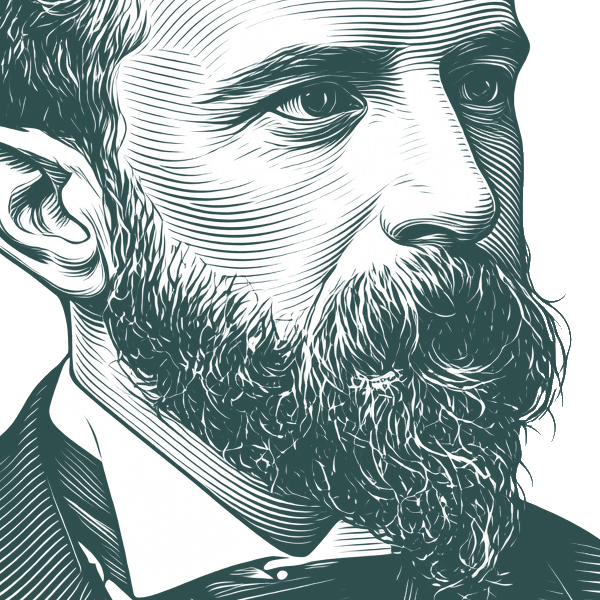
Henry Brooks Adams (16 February 1838 – 27 March 1918) was a U.S. historian, journalist, novelist and educator. He was the great-grandson of John Adams, grandson of John Quincy Adams and son of Charles Francis Adams, Sr.
Biography information from
Wikiquote·
Portrait adapted from
Wikimedia Commons, William Notman (Public domain / CC0)
Saint Thomas is still alive and overshadows as many schools as he ever did; at all events as many as the Church maintains. He has outlived Descartes and Leibnitz and a dozen other schools of philosophy more or less serious in their day. He has mostly outived Hume, Voltaire and the militant sceptics. His method is typical and classic; his sentences, when interpreted by the Church, seem, even to an untrained mind, intelligible and consistent; his Church Intellectual remains practically unchanged, and, like the Cathedral of Beauvais, erect although the storms of six or seven centuries have prostrated, over and over again, every other social or political or juristic shelter. Compared with it, all modern systems are complex and chaotic, crowded with self-contradictions, anomalies, impracticable functions and out-worn inheritances; but beyond all their practical shortcomings is their fragmentary character. An economic civilisation troubles itself about the universe much as a hive of honey-bees troubles about the ocean, only as a region to be avoided. The hive of Saint Thomas sheltered God and Man, Mind and Matter, The Universe and the Atom, the One and the Multiple, within the walls of a harmonious home.
He took their facts for granted. He knew no more than a firefly about rays — or about race or sex — or ennui — or a bar of music — or a pang of love — or a grain of musk — or of phosphorus — or conscience — or duty — or the force of Euclidian geometry — or non-Euclidian — or heat — or light — or osmosis — or electrolysis — or the magnet — or ether — or vis inertiae — or gravitation — or cohesion — or elasticity — or surface tension — or capillary attraction — or Brownian motion — or of some scores, or thousands, or millions of chemical attractions, repulsions or indifferences which were busy within and without him; or, in brief, of Force itself, which, he was credibly informed, bore some dozen definitions in the textbooks, mostly contradictory, and all, as he was assured, beyond his intelligence.
Try QuoteGPT
Chat naturally about what you need. Each answer links back to real quotes with citations.
Science itself had been crowded so close to the edge of the abyss that its attempts to escape were as metaphysical as the leap.