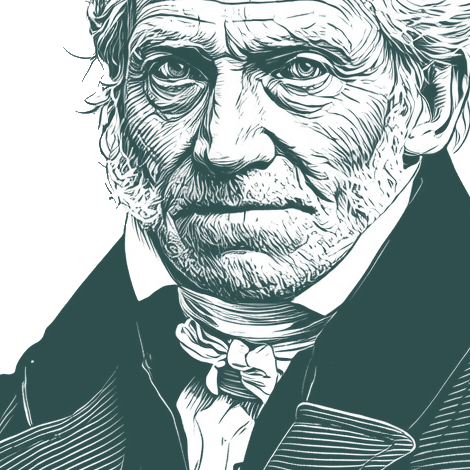
Life is a task to be done. It is a fine thing to say defunctus est; it means that the man has done his task. - Arthur Schopenhauer
""
Life is a task to be done. It is a fine thing to say defunctus est; it means that the man has done his task.
English
Collect this quote
About
Arthur Schopenhauer
Arthur Schopenhauer (22 February 1788 – 21 September 1860) was a German philosopher, most famous for his work The World as Will and Representation (1819).
Biography information from
Wikiquote·
Portrait adapted from
Wikimedia Commons, Johann Schäfer (Public domain / CC0)
The poet presents the imagination with images from life and human characters and situations, sets them all in motion and leaves it to the beholder to let these images take his thoughts as far as his mental powers will permit. This is why he is able to engage men of the most differing capabilities, indeed fools and sages together. The philosopher, on the other hand, presents not life itself but the finished thoughts which he has abstracted from it and then demands that the reader should think precisely as, and precisely as far as, he himself thinks. That is why his public is so small.
As the biggest library if it is in disorder is not as useful as a small but well-arranged one, so you may accumulate a vast amount of knowledge but it will be of far less value to you than a much smaller amount if you have not thought it over for yourself; because only through ordering what you know by comparing every truth with every other truth can you take complete possession of your knowledge and get it into your power.
Try QuoteGPT
Chat naturally about what you need. Each answer links back to real quotes with citations.
Life presents itself first and foremost as a task: the task of maintaining itself, the task of earning one's living. If this task is accomplished, what has been gained is a burden, and there then appears a second task: that of doing something with it so as to ward off boredom, which hovers over every secure life like a bird of prey. Thus the first task is to gain something and the second to become unconscious of what has been gained, which is otherwise a burden.