French mathematician, physicist, inventor, writer, and Christian philosopher (1623-1662)
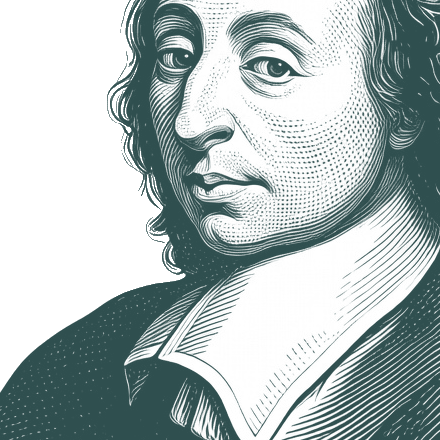
Blaise Pascal (19 June 1623 – 19 August 1662) was a French mathematician, logician, physicist and theologian.
Bio from: Wikiquote (CC BY-SA 4.0) · Portrait adapted from: Wikimedia Commons, unknown; a copy of the painting of François II Quesnel, which was made for Gérard Edelinck en 1691[réf. nécessaire]. (Public domain / CC0)
From Wikidata (CC0)

Let them at least learn what is the religion they attack, before attacking it. If this religion boasted of having a clear view of God, and of possessing it open and unveiled, it would be attacking it to say that we see nothing in the world which shows it with this clearness. But since, on the contrary, it says that men are
"Why are we not angry if we are told that we have a headache, and why are we angry if we are told that we reason badly, or choose wrongly?" The reason is that we are quite certain that we have not a headache, or are not lame, but we are not so sure that we make a true choice. So having assurance only because we see with our whole sight, it puts us into suspense and surprise when another with his whole sight sees the opposite, and still more so when a thousand others deride our choice. For we must prefer our own lights to those of so many others, and that is bold and difficult.
228. Objection of atheists: “But we have no light.” 229. This is what I see and what troubles me. I look on all sides, and I see only darkness everywhere. Nature presents to me nothing which is not matter of doubt and concern. If I saw nothing there which revealed a Divinity, I would come to a negative conclusion; if I saw everywhere the signs of a Creator, I would remain peacefully in faith. But, seeing too much to deny and too little to be sure, I am in a state to be pitied; wherefore I have a hundred times wished that if a God maintains nature, she should testify to Him unequivocally, and that, if the signs she gives are deceptive, she should suppress them altogether; that she should say everything or nothing, that I might see which cause I ought to follow. Whereas in my present state, ignorant of what I am or of what I ought to do, I know neither my condition nor my duty. My heart inclines wholly to know, where is the true good, in order to follow it; nothing would be too dear to me for eternity. I envy those whom I see living in the faith with such carelessness, and who make such a bad use of a gift of which it seems to me I would make such a different use. 230. It is incomprehensible that God should exist, and it is incomprehensible that He should not exist, that the soul should be joined to the body, and that we should have no soul; that the world should be created, and that it should not be created, &c.; that original sin should be, and that it should not be.
So I hold out my arms to my Redeemer, who, having been foretold for four thousand years, has come to suffer and to die for me on earth, at the time and under all the circumstances foretold. By His grace, I await death in peace, in the hope of being eternally united to Him. Yet I live with joy, whether in the prosperity which it pleases Him to bestow upon me, or in the adversity which He sends for my good, and which He has taught me to bear by His example. 737