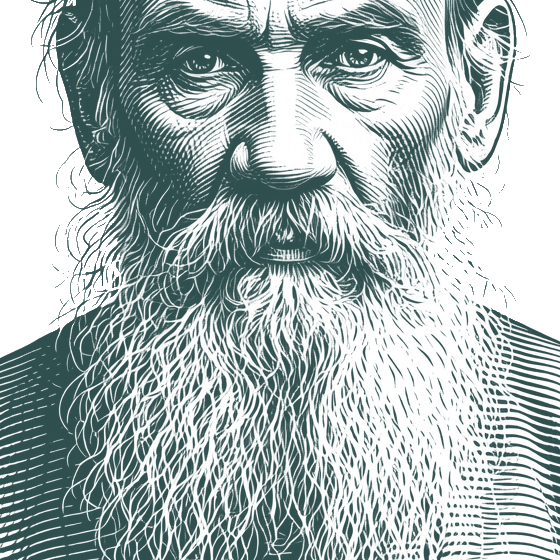
Stepan Arkadyevitch took in and read a liberal paper, not an extreme one, but one advocating the views held by the majority. And in spite of the fact… - Leo Tolstoy
""
Stepan Arkadyevitch took in and read a liberal paper, not an extreme one, but one advocating the views held by the majority. And in spite of the fact that science, art, and politics had no special interest for him, he firmly held those views on all these subjects which were held by the majority and by his paper, and he only changed them when the majority changed them — or, more strictly speaking, he did not change them, but they imperceptibly changed of themselves within him.
English
Collect this quote
About
Leo Tolstoy
Lev Nikolayevitch Tolstoy [Ле́в Никола́евич Толсто́й, usually rendered Leo Tolstoy, or sometimes Tolstoi] (9 September 1828 – 20 November 1910) was a Russian writer, philosopher and social activist (social critic), whose novels War and Peace and Anna Karenina are internationally praised classics of world literature. He was a major influence on the development of Christian anarchism and pacifism, contributing to such nonviolent resistance movements as those of Mahatma Gandhi, Martin Luther King, Jr., and James Bevel.
Biography information from
Wikiquote·
Portrait adapted from
Wikimedia Commons, Sergei Prokudin-Gorskii (Public domain / CC0)
Also Known As
Pen Names:
Л. Н. Т.
•
Л. Н.
Birth Name:
Lev Nikolayevich Tolstoy
Native Name:
Лев Никола́евич Толсто́й
Alternative Names:
Count Lev Nikolayevich Tolstoy
•
Tolstoy, Leo, graf, 1828-1910
•
Tolstoĭ, Lev Nikolaevich, graf, 1828-1910
•
Lev Nikolayevich Tolstoĭ
•
Leo Tolstoi
•
Tolstoĭ, Lev Nikolaevich, graf
•
Tolstoy, Leo, graf
Anna Pávlovna's reception was in full swing. The spindles hummed steadily and ceaselessly on all sides. With the exception of the aunt, beside whom sat only one elderly lady, who with her thin careworn face was rather out of place in this brilliant society, the whole company had settled into three groups. One, chiefly masculine, had formed round the abbé. Another, of young people, was grouped round the beautiful Princess Hélène, Prince Vasíli's daughter, and the little Princess Bolkónskaya, very pretty and rosy, though rather too plump for her age. The third group was gathered round Mortemart and Anna Pávlovna.
Several times I asked myself, "Can it be that I have overlooked something, that there is something which I have failed to understand? Is it not possible that this state of despair is common to everyone?" And I searched for an answer to my questions in every area of knowledge acquired by man. For a long time I carried on my painstaking search; I did not search casually, out of mere curiosity, but painfully, persistently, day and night, like a dying man seeking salvation. I found nothing.
Enhance Your Quote Experience
Enjoy ad-free browsing, unlimited collections, and advanced search features with Premium.
It occurred to him that he had not spent his life as he should have done. It occurred to him that his scarcely perceptible attempts to struggle against what was considered good by the most highly placed people, those scarcely noticeable impulses which he had immediately suppressed, might have been the real thing, and all the rest false. And his professional duties and the whole arrangement of his life and of his family, and all his social and official interests, might all have been false.