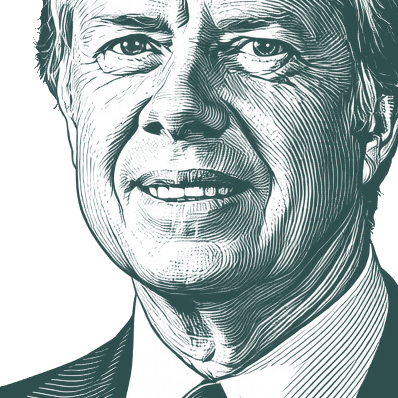
I have experienced the intensity of patriotism as a submarine officer, the ambitions of a competitive businessman, and the intensity of political deb… - Jimmy Carter
""
I have experienced the intensity of patriotism as a submarine officer, the ambitions of a competitive businessman, and the intensity of political debate. I have been sorely tempted to launch a military attack on foreigners, and have felt the frustration of having to negotiate with allies or even former enemies to reach a consensus instead of taking more decisive unilateral action.
English
Collect this quote
About
Jimmy Carter
James Earl Carter, Jr. (October 1, 1924 – December 29, 2024) was an American politician and member of the Democratic Party who served as the 39th president of the United States from 1977 to 1981. In 1982 he established the Carter Center, as a base for promoting human rights, democracy, finding peaceful solutions to international conflicts, and advancing economic and social development, for which he was awarded the Nobel Peace Prize in 2002. He was a key figure in the Habitat for Humanity project, and has been noted for his criticism of Israel's role in the Israeli–Palestinian conflict.
Biography information from
Wikiquote·
Portrait adapted from
Wikimedia Commons, Department of Defense. Department of the Navy. Naval Photographic Center (Public domain / CC0)
Also Known As
Birth Name:
James Earl Carter Jr.
Alternative Names:
James E. Carter
•
James Carter
•
James Earl Carter
•
39th President of the United States
•
James E. Carter Jr.
•
James Earl Carter, Jr.
•
James E. Carter, Jr.
Portrait from Wikimedia Commons. Credit: Department of Defense. Department of the Navy. Naval Photographic Center. Used under Public domain / CC0. Processed and styled by Quotewise.
Works in ChatGPT, Claude, or Any AI
Add semantic quote search to your AI assistant via MCP. One command setup.
This year we are faced with a deficit that's about $15 or $20 billion higher than it would have been because we're trying to give a tax break, tax reduction, to the American people. In every instance, you have to make a judgment on that. One of the reasons that we are giving the tax reduction is because the taxes are too high; another one is that it would result in a stimulated economy, a million more people at work and paying taxes rather than on the Federal dole. And so you have to make a judgment. We have expectations, with some fairly accurate projections, that the budget deficit next year, fiscal year 1980, will be considerably below 1979. And if the economy continues to progress, then I have good hopes that in 1981 we will reach my goal. Obviously, I don't have complete control over the economy. But I've not given up in trying to carry out the principles that Adam Smith espoused in your quote.
We didn't consider it to fall in the legal definition of a disaster area. Those definitions are established very clearly in the Federal law. And the department leaders involved, Patricia Harris in HUD and others, analyzed the situation in New York as best we could, analyzed the definition of a disaster area in the law, and found out that it didn't match. We did make a special allocation through Housing and Urban Development, Commerce, EDA, Labor, and other departments--including the Justice Department, to expedite the hearings on those that were accused of looting--I think a total package of about $11.4 million. I doubt that any more money would have been allocated to the city if it had received an official declaration. So we did all we could within the bounds of the law to recognize the problem in New York.
Unlimited Quote Collections
Organize your favorite quotes without limits. Create themed collections for every occasion with Premium.
The other comment I'd like to make is concerning the Middle East. In the last few days we have seen, I believe, an historic breakthrough in the search for a permanent, lasting peace in the Middle East because of the true leadership qualities that have been exhibited by the courage of President Sadat and the gracious reception of him in Israel by Prime Minister Begin. This has been, already, a tremendous accomplishment. I think the importance of it is that there has been an initiation of direct, person-to-person negotiations between Israel and the major power in the Mideast among the Arab nations who are Israel's neighbors. Lebanon, Syria, Jordan have a total population of about 12 million; Egypt has a population of 36 million and has by far the greatest military force. And the fact that this strongest Arab country and the nation of Israel are now conducting direct negotiations is a major accomplishment in itself. Two of Israel's most cherished desires have already been met. One is this face-to-face negotiation possibility, and the other one is a recognition by a major Arab leader that Israel has a right to exist. In fact, President Sadat said, "We welcome you in our midst." The United States has been very pleased to see this reduction in distrust and a reduction in fear and a reduction in suspicion between the Arabs and the Israelis. We have played a close consultative role with both of these leaders. We have, on several instances recently, acted as intermediaries at their request. Both Prime Minister Begin and President Sadat have publicly expressed their reconfirmation that these exploratory talks are designed to lead toward a comprehensive settlement including Israel and all her neighbors.Sunday, President Sadat called for a conference in Cairo. This is likely to be held around the 13th of December, about the middle of December. We will participate in that conference at a high level--Assistant Secretary Atherton will represent our Nation. We look on this as a very constructive step. The road toward peace has already led through Jerusalem, will now go to Cairo and ultimately, we believe, to a comprehensive consultation at Geneva. It's not an easy thing to bring about a comprehensive peace settlement. Immediate expectations have sometimes been exaggerated. The definition of real peace--I think we've made good progress on that already. The resolution of the Palestinian question still has not been decided. And the solution to the problem concerning borders and national security has also not been decided. We have played, I think, a proper role. I have tried to convince, in the past, Prime Minister Begin of the good intentions of President Sadat and vice versa. When there has been no progress being made, the United States has taken the initiative. Now that progress is being made, a proper role for the United States is to support that progress and to give the credit to the strong leadership that's already been exhibited by Prime Minister Begin and President Sadat and to let our Nation be used, as called upon, to expedite the peace process. I believe that this is a move that the whole world looks upon with great appreciation. And again, I want to express my congratulations and my appreciation to these two strong leaders for the tremendous progress already made and for their commitment to future progress.