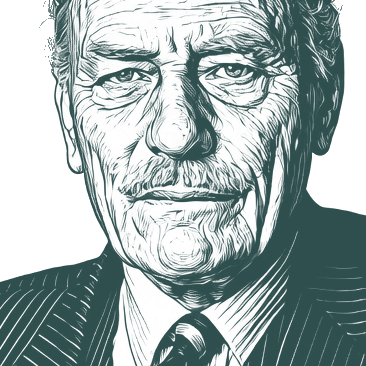
To tell the indigenous inhabitants of Brixton or Southall or Leicester or Bradford or Birmingham or Wolverhampton, to tell the pensioners ending thei… - Enoch Powell
""
To tell the indigenous inhabitants of Brixton or Southall or Leicester or Bradford or Birmingham or Wolverhampton, to tell the pensioners ending their days in streets of nightly terror unrecognisable as their former neighbourhoods, to tell the people of towns and cities where whole districts have been transformed into enclaves of foreign lands, that "the man with a coloured face could be an enrichment to my life and that of my neighbours" is to drive them beyond the limits of endurance. It is not so much that it is obvious twaddle. It is that it makes cruel mockery of the experience and fears of hundreds of thousands, if not millions, of ordinary, decent men and women...In understanding this matter, the beginning of wisdom is to grasp the law that in human societies power is never left unclaimed and unused...Men's nature is not only, as Thucydides long ago asserted, to exert power where they have it: men cannot help themselves from exerting power where they have it, whether they want to or not...It is the business of the leaders of distinct and separate populations to see that the power which they possess is used to benefit those for whom they speak. Leaders who fail to do so, or to do so fast enough, find themselves outflanked and superseded by those who are less squeamish. The Gresham's Law of extremism, that the more extreme drives out the less extreme, is one of the basic rules of political mechanics which operate in this field...Both the general law and its Gresham's corollary point, in contemporary circumstances, towards the resort to physical violence, in the form of firearms or high explosive, as being so probable as to be predicted with virtual certainty. The experience of the last decade and more, all round the world, shows that acts of violence, however apparently irrational or inappropriate their targets, precipitate a frenzied search on the part of the society attacked to discover and remedy more and more grievances, real or imaginary, among those from whom the violence is supposed to emanate or on whose behalf it is supposed to be exercised. Those commanding a position of political leverage would then be superhuman if they could refrain from pointing to the acts of terrorism and, while condemning them, declaring that further and faster concessions and grants of privilege are the only means to avoid such acts being repeated on a rising scale. This is what produces the gearing effect of terrorism in the contemporary world, yielding huge results from acts of violence perpetrated by minimal numbers. It is not, I repeat again and again, that the mass of a particular population are violently or criminally disposed. Far from it; that population soon becomes itself the prisoner of the violence and machinations of an infinitely small minority among it. Just a few thugs, a few shots, a few bombs at the right place and time – and that is enough for disproportionate consequences to follow.
John Enoch Powell (16 June 1912 – 8 February 1998) was a British politician, classical scholar, author, linguist, soldier, philologist, and poet. He served as a Conservative Member of Parliament (1950–1974), then Ulster Unionist Party (UUP) MP (1974–1987), and was Minister of Health (1960–1963).
The Bill ... does manifest some of the major consequences. It shows first that it is an inherent consequence of accession to the Treaty of Rome that this House and Parliament will lose their legislative supremacy. It will no longer be true that law in this country is made only by or with the authority of Parliament... The second consequence ... is that this House loses its exclusive control—upon which its power and authority has been built over the centuries—over taxation and expenditure. In future, if we become part of the Community, moneys received in taxation from the citizens of this country will be spent otherwise than upon a vote of this House and without the opportunity ... to debate grievance and to call for an account of the way in which those moneys are to be spent. For the first time for centuries it will be true to say that the people of this country are not taxed only upon the authority of the House of Commons. The third consequence which is manifest on the face of the Bill, in Clause 3 among other places, is that the judicial independence of this country has to be given up. In future, if we join the Community, the citizens of this country will not only be subject to laws made elsewhere but the applicability of those laws to them will be adjudicated upon elsewhere; and the law made elsewhere and the adjudication elsewhere will override the law which is made here and the decisions of the courts of this realm.
It is advertising that enthrones the customer as king. This infuriates the socialist...[it is] the crossing of the boundary between West Berlin and East Berlin. It is Checkpoint Charlie, or rather Checkpoint Douglas, the transition from the world of choice and freedom to the world of drab, standard uniformity.
Unlimited Quote Collections
Organize your favorite quotes without limits. Create themed collections for every occasion with Premium.
We believe that a society where men are free to take economic decisions for themselves—to decide how they will apply their incomes, their savings, their efforts—is the only kind of society where men will remain free in other respects, free in speech, thought and action. It is no accident that wherever the state has taken economic decision away from the citizen, it has deprived him of his other liberties as well. It is not that there was some peculiarity in the character of the Russians or the other Communist nations which predisposed them to servitude. It is that state Socialism is incompatible with individual liberty of thought, speech and action. You may choose one or the other: you cannot have them both.