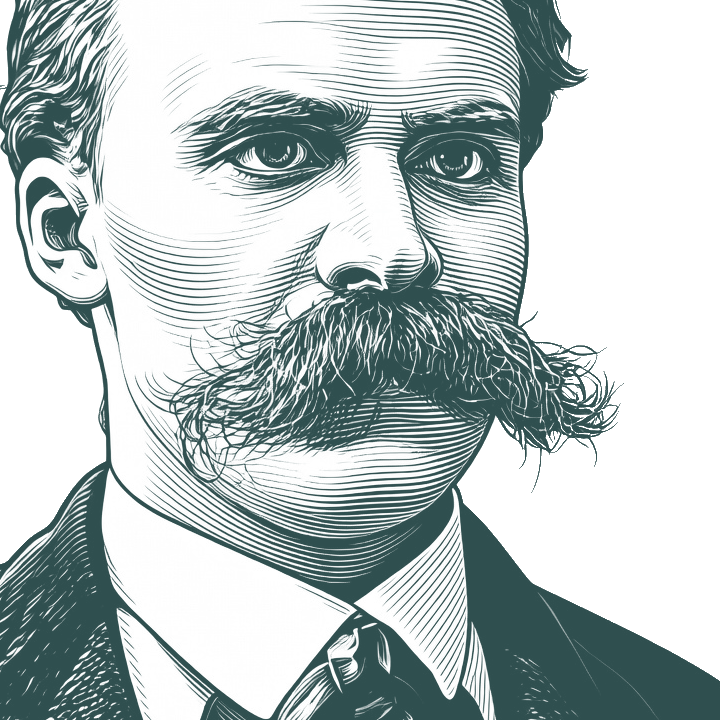
Mathematics would certainly have not come into existence if one had known from the beginning that there was in nature no exactly straight line, no ac… - Friedrich Nietzsche
""
Mathematics would certainly have not come into existence if one had known from the beginning that there was in nature no exactly straight line, no actual circle, no absolute magnitude.
Friedrich Wilhelm Nietzsche (15 October 1844 – 25 August 1900) was a German philosopher, cultural critic, composer, poet, writer, and philologist whose work has exerted a profound influence on modern intellectual history. His critiques of contemporary culture, religion, and philosophy centered on a basic question regarding the foundation of values and morality.
Biography information from
Wikiquote·
Portrait adapted from
Wikimedia Commons, Friedrich Hermann Hartmann (Public domain / CC0)
Also Known As
Alternative Names:
Friedrich Wilhelm Nietzsche
•
Nietzsche
The only thing of interest in a refuted system is the personal element. It alone is what is forever irrefutable.
I love him whose soul is deep, even in being wounded, and who may perish through a minor matter: thus he goes willingly over the bridge. I love him whose soul is so overfull that he forgets himself, and all things are in him: thus all things become his going under. I love him who has a free spirit and a free heart: thus his head is only the guts of his heart; his heart, however, causes his going under. I love all who are like heavy drops falling one by one out of the cloud that lowers over man: they herald the coming of the lightning, and as heralds they perish.
PREMIUM FEATURE
Advanced Search Filters
Filter search results by source, date, and more with our premium search tools.
Benefiting and hurting others are ways of exercising one's power upon others; that is all one desires in such cases. One hurts those whom one wants to feel one's power, for pain is a much more efficient means to that end than pleasure; pain always raises the question about its origin while pleasure is inclined to stop with itself without looking back. We benefit and show benevolence to those who are already dependent on us in some way (which means that they are used to thinking of us as causes); we want to increase their power because in that way we increase ours, or we want to show them how advantageous it is to be in our power; that way they will become more satisfied with their condition and more hostile to and willing to fight against the enemies of our power.