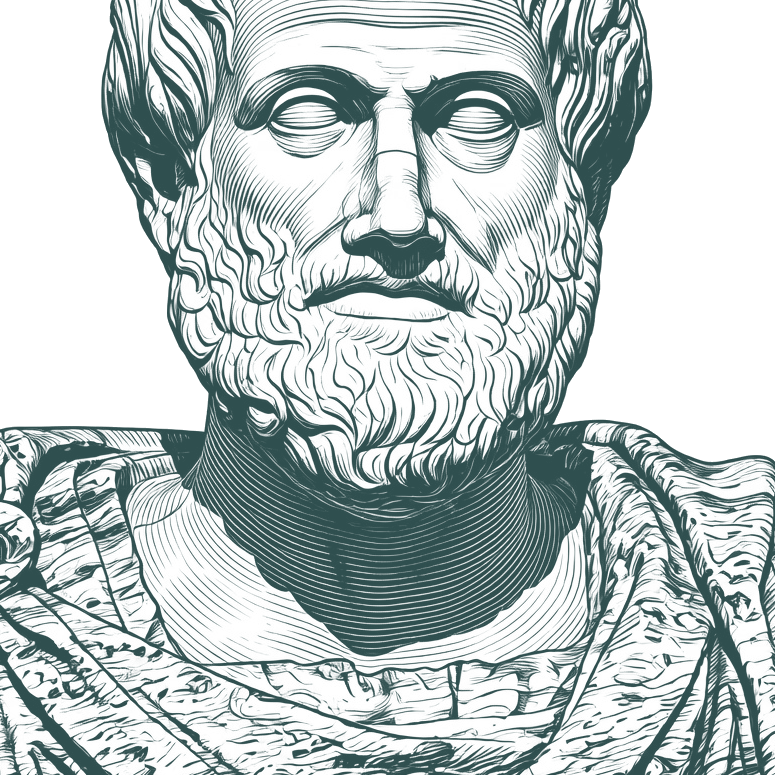
Again, it is possible to fail in many ways (for evil belongs to the class of the unlimited ... and good to that of the limited), while to succeed is … - Aristotle
""
Again, it is possible to fail in many ways (for evil belongs to the class of the unlimited ... and good to that of the limited), while to succeed is possible only in one way (for which reason also one is easy and the other difficult—to miss the mark easy, to hit it difficult); for these reasons also, then, excess and defect are characteristic of vice, and the mean of virtue; For men are good in but one way, but bad in many.
English
Collect this quote
About
Aristotle
Aristotle (Ἀριστοτέλης Aristotelēs; 384 BC – 322 BC) was a Greek philosopher and polymath during the Classical period in Ancient Greece. Taught by Plato, he was the teacher of Theophrastus and founder of the Lyceum, the Peripatetic school of philosophy, and the Aristotelian tradition. His writings cover many subjects including physics, biology, zoology, metaphysics, logic, ethics, aesthetics, poetry, theatre, music, rhetoric, psychology, linguistics, economics, politics, meteorology, geology and government. Aristotle provided a complex synthesis of the various philosophies existing prior to him. It was above all from his teachings that the West inherited its intellectual lexicon, as well as problems and methods of inquiry. As a result, his philosophy has exerted a unique influence on almost every form of knowledge in the West and it continues to be a subject of contemporary philosophical discussion.
Biography information from
Wikiquote·
Portrait adapted from
Wikimedia Commons, After Lysippos (Public domain / CC0)
Also Known As
Native Name:
Ἀριστοτέλης
Alternative Names:
the Stagirite
•
Aristotelis
•
Aristoteles
When states are democratically governed according to law, there are no demagogues, and the best citizens are securely in the saddle; but where the laws are not sovereign, there you find demagogues. The people become a monarch... such people, in its role as a monarch, not being controlled by law, aims at sole power and becomes like a master.
For tyranny is a kind of monarchy which has in view the interest of the monarch only; oligarchy has in view the interest of the wealthy; democracy of the needy: none of them common good of all.
Limited Time Offer
Premium members can get their quote collection automatically imported into their Quotewise collections.
Thus, since time immemorial, it has been customary to accept the criticism of art from a man who may or may not have been artist himself. Some believe that artist should create its art and leave it for critic to pass judgement over it. Whereas dramatists like Ben Jonson is of the view that to ‘judge of poets is only the faculty of poets; and not of all poets, but the best’. Only the best of poets have the right to pass judgments on the merit or defects of poetry, for they alone have experienced the creative process form beginning to end, and they alone can rightly understand it.