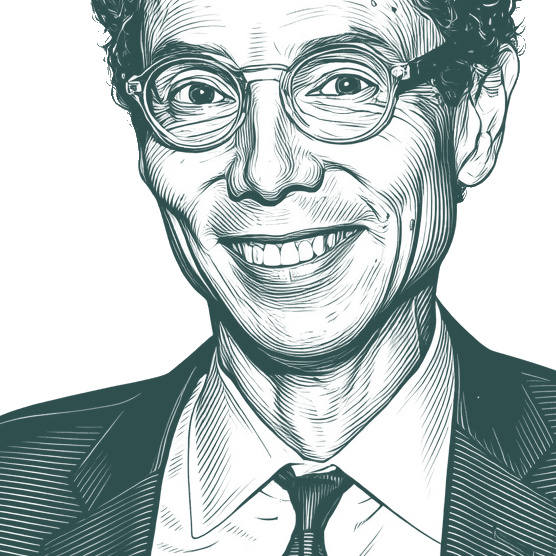
So why don’t Americans cheat? Because they think that their system is legitimate. People accept authority when they see that it treats everyone equal… - Malcolm Gladwell
""
So why don’t Americans cheat? Because they think that their system is legitimate. People accept authority when they see that it treats everyone equally, when it is possible to speak up and be heard, and when there are rules in place that assure you that tomorrow you won’t be treated radically different from how you are treated today. Legitimacy is based on fairness, voice and predictability, and the U.S. government, as much as Americans like to grumble about it, does a pretty good job of meeting all three standards. Pg. 293
Malcolm Timothy Gladwell (born September 3, 1963) is an English-born Canadian journalist, bestselling author, and speaker. He has been a staff writer for The New Yorker since 1996.
Biography information from
Wikiquote·
Portrait adapted from
Wikimedia Commons, PEN American Center (CC BY)
We take it for granted that the Big Pond expands opportunities, just as we take it for granted that a smaller class is always a better class. We have a definition in our heads of what an advantage is — and the definition isn’t right. And what happens as a result? It means that we make mistakes. It means that we misread battles between underdogs and giants. It means that we underestimate how much freedom there can be in what looks like a disadvantage. It’s the Little Pond that maximizes your chances to do whatever you want.
Suppose you were to total up all the wars over the past two hundred years that occurred between very large and very small countries. Let’s say that one side has to be at least ten times larger in population and armed might than the other. How often do you think the bigger side wins? Most of us, I think, would put that number at close to 100 percent. A tenfold difference is a lot. But the actual answer may surprise you. When the political scientist Ivan Arreguín-Toft did the calculation a few years ago, what he came up with was 71.5 percent. Just under a third of the time, the weaker country wins. Arreguín-Toft then asked the question slightly differently. What happens in wars between the strong and the weak when the weak side does as David did and refuses to fight the way the bigger side wants to fight, using unconventional or guerrilla tactics? The answer: in those cases, the weaker party’s winning percentage climbs from 28.5 percent to 63.6 percent. To put that in perspective, the United States’ population is ten times the size of Canada’s. If the two countries went to war and Canada chose to fight unconventionally, history would suggest that you ought to put your money on Canada.
Unlimited Quote Collections
Organize your favorite quotes without limits. Create themed collections for every occasion with Premium.
The Mennonites have Dirk Willems, who was arrested for his religious beliefs in the sixteenth century and held in a prison tower. With the aid of a rope made of knotted rags, he let himself down from the window and escaped across the castle’s ice-covered moat. A guard gave chase. Willems made it safely to the other side. The guard did not, falling through the ice into the freezing water, and Willems stopped, went back, and pulled his pursuer to safety. For his act of compassion, he was taken back to prison, tortured, and then burned slowly at the stake as he repeated “Oh, my Lord, my God” seventy times over.8