To relate oneself expectantly to the possibility of the good is to hope. To relate oneself expectantly to the possibility of evil is to fear. By the … - Søren Kierkegaard
" "
To relate oneself expectantly to the possibility of the good is to hope. To relate oneself expectantly to the possibility of evil is to fear. By the decision to choose hope one decides infinitely more than it seems, because it is an eternal decision
English
Collect this quote
About Søren Kierkegaard
Søren Aabye Kierkegaard (5 May 1813 – 11 November 1855) was a Danish Christian philosopher and theologian, considered to be a founder of Existentialist thought and Absurdist traditions. He wrote critical texts on organized religion, Christendom, morality, ethics, psychology and philosophy of religion, displaying a fondness for metaphor, irony and parables.
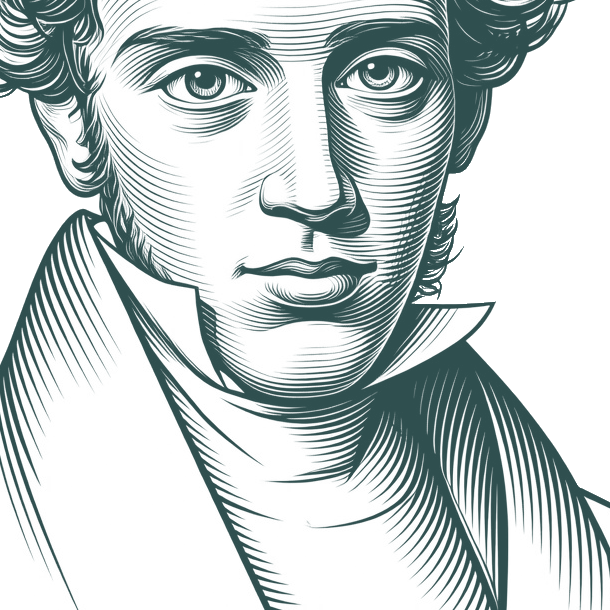
Biography information from Wikiquote · Portrait adapted from Wikimedia Commons, La Biblioteca Real de Dinamarca (Public domain / CC0)
Also Known As
Pen Names:
Victor Eremita
•
A
•
Judge William
•
Johannes de silentio
•
Constantine Constantius
•
Young Man
•
Vigilius Haufniensis
•
Nicolaus Notabene
•
Hilarius Bookbinder
•
Johannes Climacus
•
Inter et Inter
•
H.H.
•
Anti-Climacus
•
B
•
Johannes de Silentio
•
Constantin Constantius
•
P. CH. Kierkegaard
Native Name:
Søren Aabye Kierkegaard
Alternative Names:
Kierkegaard
•
Climacus
•
Sören Aaby Kierkegaard
Related quotes. More quotes will automatically load as you scroll down, or you can use the load more buttons.
Additional quotes by Søren Kierkegaard
Of all ridiculous things the most ridiculous seems to me, to be busy — to be a man who is brisk about his food and his work. Therefore, whenever I see a fly settling, in the decisive moment, on the nose of such a person of affairs; or if he is spattered with mud from a carriage which drives past him in still greater haste; or the drawbridge opens up before him; or a tile falls down and knocks him dead, then I laugh heartily.
It is the duty of the human understanding to understand that there are things which it cannot understand, and what those things are. Human understanding has vulgarly occupied itself with nothing but understanding, but if it would only take the trouble to understand itself at the same time it would simply have to posit the paradox.
Loading...