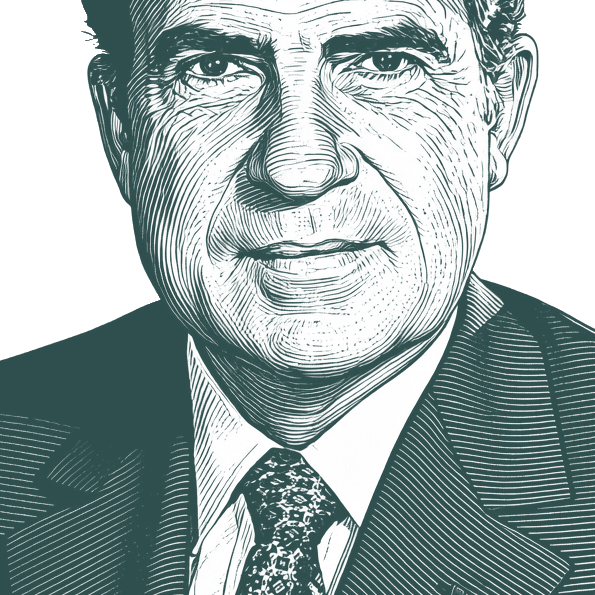
Richard Milhous Nixon (9 January 1913 – 22 April 1994) was the 37th president of the United States, serving from 1969 to 1974, when he became the only president to resign the office. Nixon had previously served as a Republican U.S. representative and senator from California from 1947 to 1952 and as the 36th vice president of the United States from 1953 to 1961.
Portrait adapted from
Wikimedia Commons, Department of Defense. Department of the Army. Office of the Deputy Chief of Staff for Operations. U.S. Army Audiovisual Center. (ca. 1974 - 05/15/1984) (Public domain / CC0)
Also Known As
Birth Name:
Richard Milhous Nixon
Also Known As:Dick Nixon
Alternative Names:
Nixon
•
President Nixon
•
R. Nixon
•
R. M. Nixon
•
Richard M. Nixon
•
Tricky Dick
•
President Richard Nixon
Portrait from Wikimedia Commons. Credit: Department of Defense. Department of the Army. Office of the Deputy Chief of Staff for Operations. U.S. Army Audiovisual Center. (ca. 1974 - 05/15/1984). Used under Public domain / CC0. Processed and styled by Quotewise.
Try QuoteGPT
Chat naturally about what you need. Each answer links back to real quotes with citations.
Related quotes. More quotes will automatically load as you scroll down, or you can use the load more buttons.
I have the greatest affection for them but I know they're not going to make it for 500 years. They aren't. You know it, too. The Mexicans are a different cup of tea. They have a heritage. At the present time they steal, they're dishonest, but they do have some concept of family life. They don't live like a bunch of dogs, which the Negroes do live like.
Looking back over the history of the cases, as I said when you were here before on the; Burger matter, among my heroes of the Court is Louis Brandeis. If philosophy were a test for him, he would have been ruled out because he was too liberal. Another was Charles Evans Hughes. If philosophy had been a test for him he would have been ruled out because he was too conservative in representing the business interests. As far as philosophy is concerned, I would be inclined to agree with the writer for the St. Louis Post Dispatch who said he thought Judge Haynsworth was a man with a razor sharp mind and a middle of the road record on the major issues. But if Judge Haynsworth's philosophy leans to the conservative side, in my view that recommends him to me. I think the Court needs balance, and I think that the Court needs a man who is conservative and I use the term not in terms of economics, but conservative, as I said of Judge Burger, conservative in respect to his attitude towards the Constitution. It is the judge's responsibility and the Supreme Court's responsibility, to interpret the Constitution and interpret the law, and not to go beyond that in putting his own socio-economic philosophy into decisions in a way that goes beyond the law, beyond the Constitution
And then finally, one point that I think is a bit sensitive but perhaps needs to be discussed at a meeting like this: At the present time, this administration, like its predecessor, and as will be the case with its successor, is struggling with the problem of welfare. What do we do about it? What should the level be? Should we have a national standard? Should we raise the standard? And, as I have been looking at the various proposals with regard to welfare that have come across my desk, a thought has come to my mind that I am sure must come to yours: The word "welfare," I think, is, in a sense, an inaccurate term if we are thinking of the welfare of the individual in the broadest sense. Welfare is necessary--necessary when an individual is unable to get a job, necessary when an individual needs help. But when we think about the welfare of this country and the welfare of an individual, in the best sense, that means a job. That is truly in the best interest of the welfare of the Nation and the welfare of every individual, because with that job comes dignity, dignity that cannot come, of course, from being on public welfare, no matter how high we are able to raise it, no matter how much we are able to do. I am not indicating here any intention on the part of this administration not to do what is required and as much as we can do to take care of those who are unable to care for themselves, who cannot find jobs. But I am emphasizing here that when we are speaking of the welfare of an individual, we should not stop in terms of what government can do for him, but we should think in terms of that dignity that can only come from what he does for himself.