If a person is unwilling to make a decisive resolution, if he wants to cheat God of the heart's daring venture in which a person ventures way out and… - Søren Kierkegaard
""
If a person is unwilling to make a decisive resolution, if he wants to cheat God of the heart's daring venture in which a person ventures way out and loses sight of all shrewdness and probability, indeed, takes leave of his senses or at least all his worldly mode of thinking, if instead of beginning with one step he almost craftily seeks to find out something, to have the infinite certainty changed into a finite certainty, then this discourse will not be able to benefit him. There is an upside-downness that wants to reap before it sows; there is a cowardliness that wants to have certainty before it begins. There is a hypersensitivity so copious in words that it continually shrinks from acting; but what would it avail a person if, double-minded and fork-tongued he wanted to dupe God, trap him in probability, but refused to understand the improbable, that one must lose everything in order to gain everything, and understand it so honestly that, in the most crucial moment, when his soul is already shuddering at the risk, he does not again leap to his own aid with the explanation that he has not yet fully made a resolution but merely wanted to feel his way. Therefore, all discussion of struggling with God in prayer, of the actual loss (since if pain of annihilation is not actually suffered, then the sufferer is not yet out upon the deep, and his scream is not the scream of danger but in the face of danger) and the figurative victory cannot have the purpose of persuading anyone or of converting the situation into a task for secular appraisal and changing God's gift of grace to the venture into temporal small change for the timorous. It really would not help a person if the speaker, by his oratorical artistry, led him to jump into a half hour's resolution, by the ardor of conviction started a fire in him so that he would blaze in a momentary good intention without being able to sustain a resolution or to nourish an intention as soon as the speaker stopped talking.
English
Collect this quote
About
Søren Kierkegaard
Søren Aabye Kierkegaard (5 May 1813 – 11 November 1855) was a Danish Christian philosopher and theologian, considered to be a founder of Existentialist thought and Absurdist traditions. He wrote critical texts on organized religion, Christendom, morality, ethics, psychology and philosophy of religion, displaying a fondness for metaphor, irony and parables.
Biography information from
Wikiquote·
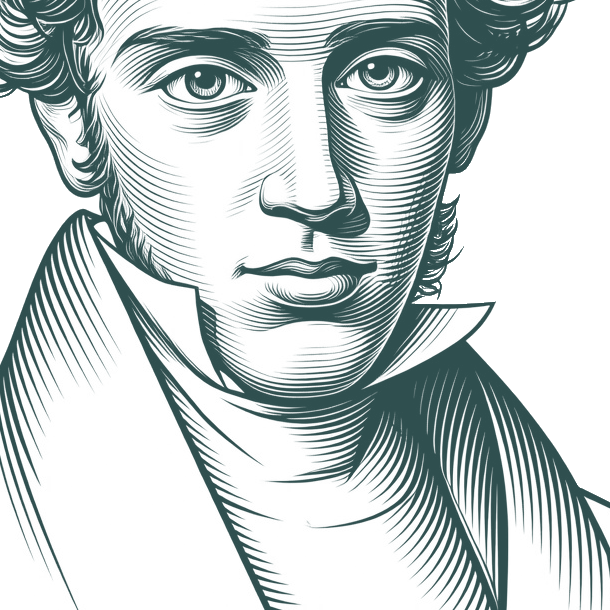
Portrait adapted from
Wikimedia Commons, La Biblioteca Real de Dinamarca (Public domain / CC0)
Also Known As
Pen Names:
Victor Eremita
•
A
•
Judge William
•
Johannes de silentio
•
Constantine Constantius
•
Young Man
•
Vigilius Haufniensis
•
Nicolaus Notabene
•
Hilarius Bookbinder
•
Johannes Climacus
•
Inter et Inter
•
H.H.
•
Anti-Climacus
•
B
•
Johannes de Silentio
•
Constantin Constantius
•
P. CH. Kierkegaard
Native Name:
Søren Aabye Kierkegaard
Alternative Names:
Kierkegaard
•
Climacus
•
Sören Aaby Kierkegaard
The more one suffers, the more, I believe, has one a sense for the comic.
It is as useless for a person to want first of all to decide the externals and after that the fundamentals as it is for a cosmic body, thinking to form itself, first of all to decide the nature of its surface, to what bodies it should turn its light, which its dark side, without first letting the harmony of centrifugal and centripetal forces realize its existence and letting the rest come of itself. One must learn to know oneself before knowing anything else (gnothi seauton). Not until a person has inwardly understood himself and then sees the course he is to take does his life gain peace and meaning.
Go Premium
Support Quotewise while enjoying an ad-free experience and premium features.
The task is not to find the lovable object, but to find the object before you lovable – whether given or chosen – and to be able to continue finding this one lovable, no matter how that person changes. To love is to love the person one sees.