Spinoza says that if a stone which has been projected through the air, had consciousness, it would believe that it was moving of its own free will. I… - Arthur Schopenhauer
""
Spinoza says that if a stone which has been projected through the air, had consciousness, it would believe that it was moving of its own free will. I add this only, that the stone would be right. The impulse given it is for the stone what the motive is for me, and what in the case of the stone appears as cohesion, gravitation, rigidity, is in its inner nature the same as that which I recognise in myself as will, and what the stone also, if knowledge were given to it, would recognise as will.
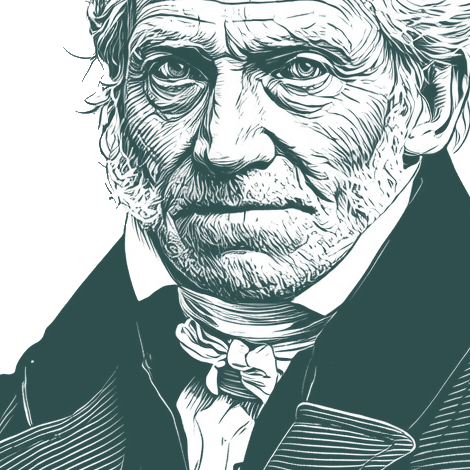
Arthur Schopenhauer (22 February 1788 – 21 September 1860) was a German philosopher, most famous for his work The World as Will and Representation (1819).
Biography information from
Wikiquote·
Portrait adapted from
Wikimedia Commons, Johann Schäfer (Public domain / CC0)
A mother gave her children Aesop’s fables to read, in the hope of educating and improving their minds; but they very soon brought the book back, and the eldest, wise beyond his years, delivered himself as follows: This is no book for us; it’s much too childish and stupid. You can’t make us believe that foxes and wolves and ravens are able to talk; we’ve got beyond stories of that kind! In these young hopefuls you have the enlightened Rationalists of the future.
Die dem Satz vom Grunde nachgehende ist die vernünftige Betrachtungsart, welche im praktischen Leben, wie in der Wissenschaft, allein gilt und hilft: die vom Inhalt jenes Satzes wegsehende ist die geniale Betrachtungsart, welche in der Kunst allein gilt und hilft.
Go Premium
Support Quotewise while enjoying an ad-free experience and premium features.
That you should write down valuable ideas that occur to you as soon as possible goes without saying: we sometimes forget even what we have done, so how much more what we have thought.