Late, I learned that when reason died, then Wisdom was born; before that liberation, I had only knowledge. - Aurobindo Ghosh
""
Late, I learned that when reason died, then Wisdom was born; before that liberation, I had only knowledge.
English
Collect this quote
About
Aurobindo Ghosh
Sri Aurobindo [born Aravinda Akroyd Ghose] (15 August 1872 – 5 December 1950) was an Indian nationalist, scholar, poet, mystic, philosopher, yogi and guru, who developed concepts of human progress and spiritual evolution. With the help of his spiritual collaborator, Mirra Alfassa, he founded the Sri Aurobindo Ashram.
Biography information from
Wikiquote·
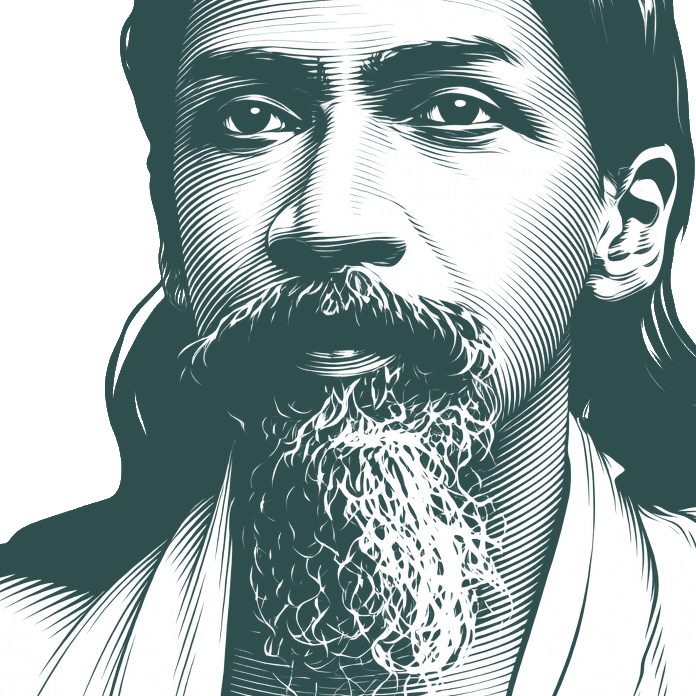
Portrait adapted from
Wikimedia Commons, Rudolf 1922 (Public domain / CC0)
Also Known As
Native Name:
অরবিন্দ ঘোষ
Alternative Names:
Sri Aurobindo Ghose
•
Sri Orobindo
•
Orobindo Ghosh
•
Shri Aurobindo
•
Aurobindo Ghose
•
Sri Aurobindo
•
Aurobindo
•
Aravinda Ackroyd Ghose
•
A.A.Ghosh
•
A.G.
•
Maharshi Aravind Babu
I was much plagued by Satan, until I found that it was God who was tempting me; then the anguish of him passed out of my soul for ever.
Life is life - whether in a cat, or dog or man. There is no difference there between a cat or a man. The idea of difference is a human conception for man's own advantage.
The Mahomedan or Islamic culture hardly gave anything to the world which may be said to be of fundamental importance and typically its own; Islamic culture was mainly borrowed from others. Their mathematics and astronomy and other subjects were derived from India and Greece. It is true they gave some of these things a new turn, but they have not created much. Their philosophy and their religion are very simple and what they call Sufism is largely the result of gnostics who lived in Persia and it is the logical outcome of that school of thought largely touched by Vedanta.... I have, however, mentioned [in The Foundations of Indian Culture] that Islamic culture contributed the Indo-Saracenic architecture to Indian culture. I do not think it has done anything more in India of cultural value. It gave some new forms to art and poetry. Its political institutions were always semi-barbaric.